 Profound Custom quote
 Peec AI $95/mo
 Otterly.AI EUR 29/mo
 Scrunch $250/mo
 AthenaHQ $295/mo
 Semrush AI Toolkit $99/mo
 Ahrefs Brand Radar $50/mo
 SE Ranking $129/mo
 Rankscale EUR 99/mo
 Promptwatch $95/mo
 Goodie $295/mo
 Evertune $60/mo
AI Visibility
AI visibility metrics: share of voice, citation rate and sentiment
Define mention rate, citation rate, share of voice, and sentiment as counts over a prompt list. No industry benchmark, only formulas you can recompute.
On this page 10 sections
- Four numbers, and the question each one answers
- The base formulas
- Worked rows, not a fake benchmark
- Share of voice, worked from one week of logs
- Sentiment without a made-up scale
- What you must not average
- A weekly sheet that matches the formulas
- How tools rename the same arithmetic
- Vendor labels mapped to the base formulas
- A check that the sheet still matches the definition
- The four formulas on one card
- A month of using the formulas
- FAQ
AI visibility metrics are counts you can recompute from a log: whether you were named, whether your domain was cited, how that compares with named competitors, and what tone a person assigned. They are not a score an answer engine publishes, and they are not a benchmark for your industry.
If a chart has no prompt list next to it, it is not one of these metrics. The list is the denominator. Change the list and you have a new metric, even when the name on the chart stays the same. How to track your brand in AI search is the log these formulas read. How to build a prompt list is how that denominator is built. This page only divides.
Four numbers, and the question each one answers
Mention rate answers: on the prompts we ran, how often was our brand string present. Citation rate answers: how often was a URL on our domain shown as a source. Share of voice answers: of the brand mentions we chose to count, what fraction were ours. Sentiment answers: among answers that mentioned us, how did a reader label the tone.
They move independently. You can be mentioned in a complaint and never cited. You can be cited as the source of a definition that does not say your name in the sentence. You can have a high share of voice on a prompt set that never names the rival your sales team actually loses to, because that rival was not in the set. Write the question on the chart title. “Citation rate, Perplexity, March prompt list” is a title. “AI score” is not.
Keep engines in separate columns. A mention in ChatGPT and a citation in an AI Overview are different events. Adding them into one rate hides which surface changed. What is AI visibility? separates mention from citation. The formulas below keep that split.
The base formulas
Use one row per prompt, per engine, per run. A run is one fresh session on one date. Flags are 1 or 0, not word counts.
| Metric | Formula | What a 0 means |
|---|---|---|
| Mention rate | prompts where mention = 1, divided by prompts run | The string was absent on every run you included |
| Citation rate (all runs) | prompts where your domain was cited, divided by prompts run | Includes runs that showed no sources at all |
| Citation rate (when sources showed) | prompts where your domain was cited, divided by prompts that showed at least one source | A missing overview or a chat that did not search is excluded |
| Share of voice | your mention flags, divided by your flags plus the competitor flags you listed | Prompts with no listed brand drop out |
| Sentiment share | mentions you labeled with one tone, divided by mentions you labeled | Unlabeled mentions are not in the denominator |
In symbols, for one engine and one prompt list:
mention_rate = mentioned_prompts / prompts_run
citation_rate_all = cited_prompts / prompts_run
citation_rate_sourced = cited_prompts / prompts_with_any_source
share_of_voice = your_mentions / (your_mentions + sum_of_listed_competitor_mentions)
sentiment_share(label) = mentions_with_label / labeled_mentions
Round only for display, and keep the raw counts beside the percentage. “3 of 10” is harder to misunderstand than “30 percent” with the 10 hidden. Do not multiply by a weight. A weighted score is a new metric and needs its own name and its own formula in the footnote.
Worked rows, not a fake benchmark
Share of voice, worked from one week of logs
Illustrative log: 20 prompts x 2 engines = 40 answers (week of 24 Nov 2026)
| Brand | Answers that name it | Mention rate (of 40) | Share of voice (of 70 brand mentions) |
|---|---|---|---|
| Your brand | 14 | 14 / 40 = 35% | 14 / 70 = 20% |
| Competitor A | 28 | 28 / 40 = 70% | 28 / 70 = 40% |
| Competitor B | 18 | 18 / 40 = 45% | 18 / 70 = 25.7% |
| Competitor C | 10 | 10 / 40 = 25% | 10 / 70 = 14.3% |
| Total brand mentions | 70 | n/a | 100% |
Mention rate uses answers as the denominator. Share of voice uses brand mentions. Never put the two in one column. These numbers are illustrative, not a benchmark.
Suppose the list has 10 prompts, run once on one engine. You were mentioned on prompts 1, 2, and 4. Your domain was cited on prompts 1 and 2. Prompt 3 showed sources but not you. Prompts 5 through 10 showed no sources. A named competitor was mentioned on prompts 2, 3, and 4.
Then mention rate is 3/10. Citation rate on all runs is 2/10. Citation rate when sources showed uses only prompts that had sources. If only prompts 1 through 4 showed sources, that denominator is 4, and your citation rate is 2/4. Both citation rates are allowed. They answer different questions. Label them. Do not call both “citation rate” in the same deck.
Share of voice, if you count mention flags and the competitor was mentioned on three prompts, is 3 / (3 + 3) = 1/2, but only if you do not double-count a prompt where both of you were named. Decide the rule in writing. The cleaner rule: a prompt can contribute 1 to you and 1 to the competitor when both names appear. Share of voice is then your flags divided by all flags, and one prompt can add 2 to the denominator. The other rule: one mention slot per prompt, awarded to you if you appear, else to the first listed competitor. That second rule hides co-mentions. Prefer the first rule and report co-mention count beside it: prompts where you and at least one listed rival both appear.
These numbers describe the example list only. They are not a target. If your list has different prompts, your rates are not comparable to this example. That is the point of writing the arithmetic out.
Sentiment without a made-up scale
Sentiment is a label on a mention, applied by a person who can see the answer. Use three labels:
- Positive: the answer recommends the brand or describes it doing the job the prompt asked.
- Neutral: the answer names the brand without a recommendation or a warning.
- Negative: the answer advises against the brand, or describes a failure as current.
Mixed answers get a fourth label, mixed, rather than a forced side. The rubric fits on a card. If two readers disagree, the label is mixed or unlabeled, not an average of their moods. sentiment_share uses only labeled mentions. If you labeled 8 of 10 mentions, the denominator is 8, and you also report 2 unlabeled. Dropping the unlabeled makes the share look more certain than the read was.
Do not convert labels to a single signed score unless you publish the map, for example positive = 1, neutral = 0, negative = -1, mixed excluded. A score of 0.4 means nothing without that map and the counts. Prefer the counts.
A tool that emits a sentiment percentage must show the rubric or it is not this metric. Best AI visibility tools is where you compare products that claim to compute these rates. Ask them which formula, which denominator, and whether you can export the flags. AI citation tracking tools is the narrower shelf when the only flag you care about is the URL.
What you must not average
Do not average mention rate and citation rate into one “visibility.” They are different events. Do not average engines. Report a small table, one row per engine. Do not average months if the prompt list changed. Show the old list’s rate through the last day it was intact, then start the new list as a new series. A jump that came from deleting hard prompts is not an improvement. Footnote the deletion.
Do not treat a missing source box as a lost citation. That is why citation_rate_all and citation_rate_sourced both exist. How to appear in Google AI Overviews depends on the sourced denominator, because an overview that did not appear cannot cite you. How ChatGPT chooses sources makes the same point when a reply never searched.
Do not import a benchmark. A vendor’s “category average” uses their prompt set and their customer base. You do not have that set. Quoting it as your gap invents a comparison. If you want a comparison, run the same prompts for the rivals you listed and use share of voice as defined here.
A weekly sheet that matches the formulas
The weekly note has, per engine: prompts_run, mentioned_prompts, cited_prompts, prompts_with_any_source, competitor mention flags, and labeled sentiment counts. Rates are calculated in the sheet from those cells, not typed by hand. Typed rates drift from the flags. Formula cells do not.
Here is a compact layout you can paste into a document. Replace the ids with yours.
engine | prompts_run | mentioned | cited | with_sources | rival_flags | positive | neutral | negative | unlabeled
Perplexity | 10 | 3 | 2 | 4 | 3 | 1 | 1 | 1 | 0
mention_rate is mentioned divided by prompts_run. citation_rate_sourced is cited divided by with_sources. If with_sources is 0, the cell is blank, not zero. Zero would claim you lost citations. Blank claims the feature did not show sources.
Store the prompt ids that make up prompts_run in a second tab. A rate that cannot point at ids will be questioned, and you will not be able to answer. What is AEO? is the work that tries to move cited. This page only tells you whether it moved.
How tools rename the same arithmetic
Vendor labels mapped to the base formulas
| Label you may see in a tool | Base formula it usually maps to | Ask the vendor |
|---|---|---|
| Visibility score, brand visibility | Mention rate, sometimes weighted by position | Is the weight published? |
| Citation share, source share | Citation rate or share of cited URLs | Are your subdomains counted? |
| Share of voice, SOV | Your mentions / all tracked brand mentions | Which competitors are in the denominator? |
| Sentiment score | Tagged answers over named answers | Is tagging human or model-based? |
If the vendor cannot name the denominator, record the raw counts in your own sheet as well.
Products will call share of voice a “presence score” or citation rate a “coverage.” Open the help doc or the export and map their field to one row of the table above. If you cannot map it, do not put their number next to yours. You would be plotting two denominators on one axis.
Ask whether their mention flag is binary per prompt or a count of repetitions inside the answer. If it is a count, it is not mention_rate as defined here. You can still track it. Name it mention_tokens or repeats, and do not divide it by prompts_run and call the result the rate in this guide.
Ask whether sentiment is a model score. If it is, keep it in a column called model_sentiment and keep the human labels separate until you have checked agreement on 20 answers. Agreement is the count of answers you and the model labeled the same, divided by answers you both labeled. That is another rate you can compute. It is not a license to delete the human column.
Prices for those products do not belong on this page. When you are ready to buy, read best AI visibility tools and best AI rank tracking software, then read the vendor’s own pricing page that day. If they do not list a price, your note says custom quote. The SaaS cost-per-seat calculator turns the quote and the seat count into a yearly figure. The software ROI calculator compares that figure with hours of hand logging you will stop. Hours you still spend auditing flags are not saved.
A check that the sheet still matches the definition
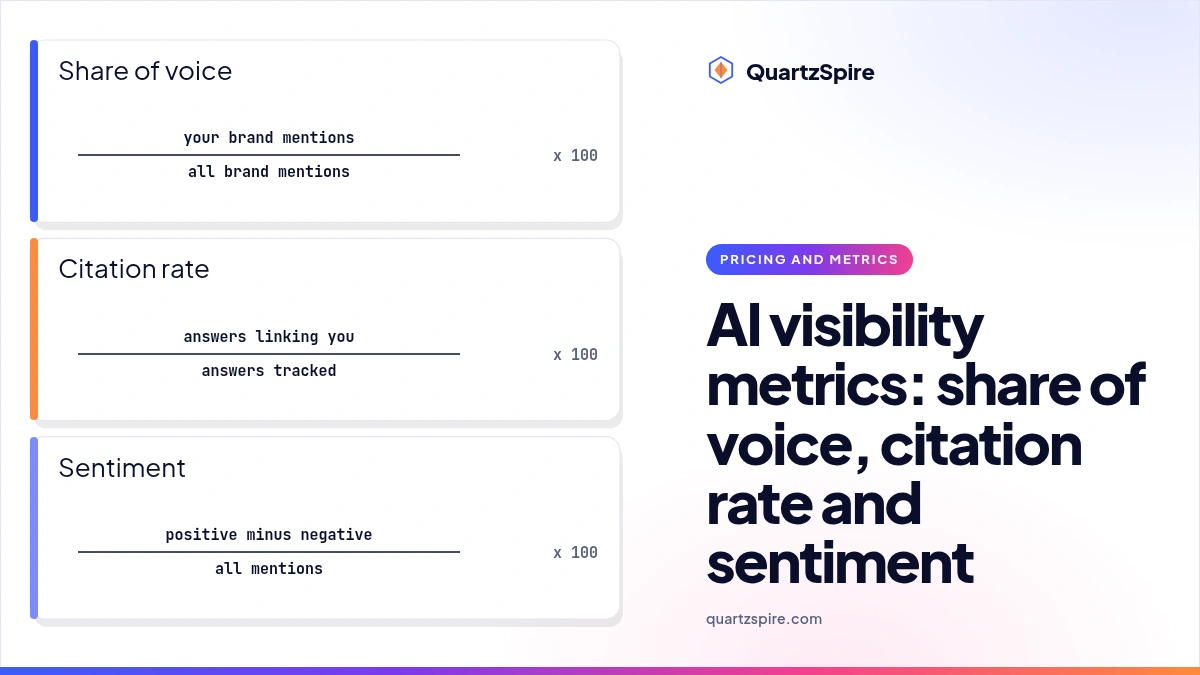
The four formulas on one card
Formula card (paste above the log)
- Mention rate = answers that name the brand / total answers logged
- Citation rate = answers that link a URL on your domain / total answers logged
- Share of voice = your brand mentions / mentions of all tracked brands (same prompts, engines, dates)
- Sentiment split = answers a reviewer tagged positive, neutral, or negative / answers that name the brand
Denominator check: if the prompt list, engine list, or location changed this week, start a new series instead of extending the old one.
Once a month, pick five prompt ids at random and recompute the rates by hand from the flags, not from the chart. If the hand rate and the chart disagree, the chart has a filter you forgot: a retired id still included, an engine mixed in, or a blank sources flag treated as zero. Fix the filter before you present. Five ids are enough to catch a broken denominator. You do not need to retype the whole month unless the five already disagree.
Write the formula next to the chart in the same sentence you would say out loud. “Mention rate is mentioned prompts divided by prompts run, Perplexity, list frozen on 24 Nov 2026.” If the sentence does not fit in the subtitle, the chart is doing too much. Split it. The meeting can look at two small charts. It cannot audit a blended one while someone is talking.
When a stakeholder asks for a target, offer a process target: every active id run, every mention labeled or marked unlabeled, export saved. A numeric target for citation rate, chosen before you have a baseline month, is a guess. After you have three comparable months, you can talk about direction. Direction is “cited prompts went from 2 to 4 on this list,” which is a count, not a new formula. Stay with counts when the room gets loud. Counts survive questions. A renamed score does not.
Keep the competitor list in the same monthly check. If a rival’s name was missing from the flags because of a spelling variant, share of voice moved for a clerical reason. Add the spelling to the match list and recompute that month before you tell a story about the market. How to build a prompt list is where the rival strings can live beside the prompt text, so the metric page and the prompt page do not drift.
A month of using the formulas
Week one, freeze the prompt list and the competitor list. Write both down. Week two, run the log and compute only mention_rate and citation_rate_sourced, per engine. Week three, add share of voice and the co-mention count. Week four, label sentiment on the mentions you have time to read, and publish sentiment_share with the unlabeled count visible.
Do not add a fifth composite. The meeting can hold a small table. A composite invites a target, and a target without a denominator becomes a fight. If someone wants a target, the only honest one is operational: run every prompt every week, label every mention, export the flags. The rates are the output. They are not the goal until you have seen them move for a reason you can point at, such as a revised page or a corrected third-party source.
GEO vs AEO vs SEO is the page to send when the meeting renames the table. The formulas stay. AI visibility tool pricing is where pricing models belong once they are checked. This page stops at the arithmetic you can do with a sheet tonight.
To turn a count into a rate, run it through the percentage calculator.
FAQ
What is a good citation rate?
There is no universal good rate. Your rate is citations divided by the prompts you chose to run. Compare it with last month's rate on the same list, not with a number from a vendor demo.
Should share of voice include prompts where nobody was named?
No. If the denominator is mentions, prompts with no brand names drop out. Report those prompts separately as unanswered, so a quiet category does not look like a high share.
Can sentiment be automated?
Only if you publish the labels and check them. A model score with no rubric is not comparable month to month. Start with three labels applied by a person: positive, neutral, negative.
Do we count a mention twice if the name appears twice in one answer?
Not in the base formulas here. One prompt, one engine, one run, one mention flag. Token counts are a different metric and should be named as such.
Which listicles cover tools that compute these rates?
Best AI visibility tools and AI citation tracking tools are the shopping pages. This page is the definition. Check any price on the vendor site the day you look.
See a factual problem? Write to hello@quartzspire.com with this page URL.