 Profound Custom quote
 Peec AI $95/mo
 Otterly.AI EUR 29/mo
 Scrunch $250/mo
 AthenaHQ $295/mo
 Semrush AI Toolkit $99/mo
 Ahrefs Brand Radar $50/mo
 SE Ranking $129/mo
 Rankscale EUR 99/mo
 Promptwatch $95/mo
 Goodie $295/mo
 Evertune $60/mo
AI Visibility
What is answer engine optimization (AEO)?
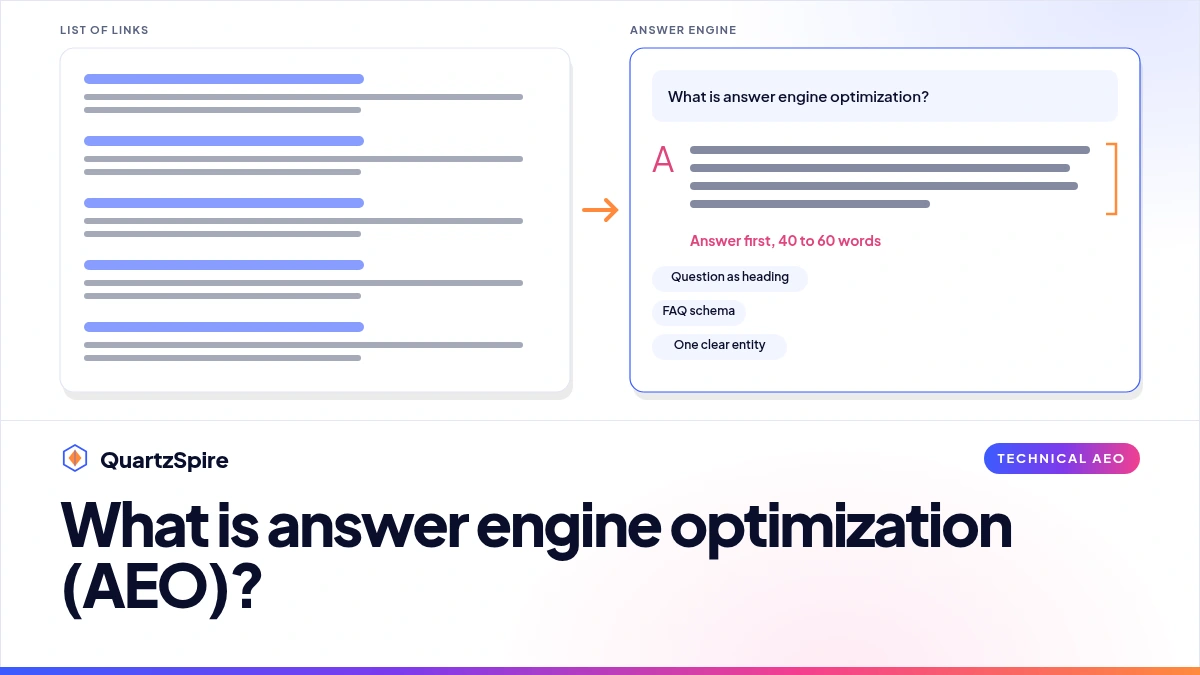
AEO is the work of making a page easy for an answer engine to retrieve, use, and cite. This guide separates that work from slogans.
On this page 10 sections
- The job, stated so a writer can do it
- What an engine can use from a page
- What an answer engine can and cannot use
- On-site work that is worth the week
- Off-site sources you do not control
- What AEO is not
- A month of AEO, in order
- Thirty-day AEO sequence
- How you know the work moved
- The edit that decides if the page is done
- Before and after: one opening
- Handoff to whoever publishes next
- FAQ
Answer engine optimization is the work of making a specific question easy to answer from pages you can stand behind, and easy to cite when an answer engine shows its sources. It is a production practice: questions, pages, sources, and a log.
It is not a secret setting, a prompt you paste into a homepage, or a guarantee that ChatGPT will name you. Engines do not offer an AEO checkbox. What they offer, when they offer it, is an answer with or without citations. Your work is to deserve the citation and to notice when you got it.
The job, stated so a writer can do it
The job is one question in, one page out. The question is something a buyer types or asks, not a keyword a tool invented to fill a quota. The page answers it in the first two sentences, then shows the steps, the limits, and the source of any number. A stranger who has never heard of your category should be able to check the claim without booking a call.
That is a higher bar than “cover the topic.” Topic pages wander. Answer pages commit. If the question is “how do I export subscribers,” the page says where the control is, what the file contains, and what it does not contain. If you do not know, you do not publish a guess. What is AI visibility? is the measurement side of the same idea. AEO is the work. Visibility is whether the work showed up in an answer.
Write the question at the top of the brief, in the buyer’s words. Then write the answer before the outline. If you cannot answer in two sentences, you are not ready to outline. Teams that outline first tend to produce a survey of the industry. Surveys are hard to cite because they do not take a position a reader can use on a Tuesday.
What an engine can use from a page
What an answer engine can and cannot use
| Usable | Hard to use |
|---|---|
| A two-sentence answer under the H1 | An answer buried after 400 words of context |
| A dated table of prices or specs | Prices in an image or behind a form |
| H2s phrased as questions with direct answers | Clever headings with no answer |
| Visible author and Last verified date | Undated pages |
| Crawlable HTML | Content rendered only after login |
Public descriptions of search-backed answers say some version of the same thing: the product retrieves pages, reads them, and writes an answer that may point back at those pages. The exact ranker is not public. You still know what a retrieved page has to survive.
It has to be fetchable. A login wall, a blocked bot, or a page that only renders text after a long script can fail a fetcher even when a human browser looks fine. robots.txt for AI crawlers is the place to decide which bots you intend to allow. Decide on purpose. A default copied from a blog post is not a policy.
It has to be quotable. The sentence that answers the question should be on the page, not only in an image, a chart with no text, or a video with no transcript. Answer engines that cite a source need a passage they can point at. If the only clear sentence is inside a screenshot, the citation has nothing stable to hold.
It has to be current enough to trust. Put a visible updated date on pages that go stale: prices, limits, policy, product steps. How much do AI visibility tools cost? is an example of the kind of page that must show when the figures were checked. An undated price is how a later answer quotes you incorrectly, and how you earn a correction you could have avoided.
It has to match the question. A page about your whole platform will lose to a page that answers the narrower question, including a page on someone else’s site. That is uncomfortable and normal. The fix is a narrower page, not a longer homepage.
On-site work that is worth the week
Start with the questions sales already answers in email. Turn each one into a URL with a stable slug. Open with the answer. Use a real table when you are comparing options or listing steps with conditions. Use a list when the order matters. Do not hide the answer below a story about the company’s founding year.
Internal links should point at the next question, not at every page in the category. From a definition, link to the how-to. From the how-to, link to the measurement sheet. This guide links to how to get your brand cited in ChatGPT because that is the next task after the page exists. It links to how to track brand mentions because otherwise you will not know if the page was used.
Headings should be the question or a direct claim, not “Unlocking the power of answers.” A heading that repeats the buyer’s wording is easier to match to a prompt later, when you are trying to see which URL got cited. Clever headings are a branding choice. They are a poor retrieval choice.
Templates help if they force the answer up top. They hurt if they force a 400-word introduction about the state of AI before the definition. QuartzSpire’s own guide template puts key takeaways and a direct opening first for that reason. Copy the order, not the sentences.
Off-site sources you do not control
Many citations in this category point at review roundups, docs, community threads, and comparison pages. Pretending AEO is only “publish more on our blog” ignores the pages engines already prefer. Make a list of the domains that show up when you run your prompt set. For each domain, write one of three next steps: pitch a correction with a source, offer a better primary page they can cite, or leave it because the page is fair and you have no standing.
Do not buy a mention and ask the publisher to hide the payment. If a placement is paid, the reader should be able to see that. Our advertising disclosure is the rule on this site. The same standard is a reasonable thing to ask of a page you want an engine to trust. Hidden payment is how a citation becomes an embarrassment when someone opens it.
Directories and “best of” lists are not magic. A list that names you and links to a dead URL is a bad source. Send the publisher the current URL. Best AI visibility tools and best AEO tools are the kind of commercial pages vendors watch. Read them as examples of the format, and check any price against the vendor site on the day. A roundup that does not show a check date is not a price source.
What AEO is not
It is not prompt injection on your own homepage, hidden text, or a block of keywords under a heading that says “for AI.” Those tactics assume the engine is a search box from 2009. They also insult the human who lands on the page from a normal result. If a sentence is not worth showing a person, do not publish it for a crawler.
It is not a claim that you “rank number one in ChatGPT.” Engines do not hand you that rank. A prompt can name you today and skip you tomorrow because the retrieved set changed. Say “cited on this prompt, on this date, in this engine.” That sentence survives contact with a screenshot.
It is not a reason to block every bot or to allow every bot. Fetching and training are different uses, and the user-agent list changes. Read the robots guide and write the policy in a ticket, with a name on it. An argument in Slack is not a robots.txt.
It is not a substitute for the product being real. An answer that cites a page and sends a buyer to a broken signup is a failed visit. Fix the page the citation lands on. The fanciest explanation of AEO will not repair a form that errors.
A month of AEO, in order
Thirty-day AEO sequence
- 01Week 1Write 20 buyer questions and freeze them as a prompt list
- 02Week 2Rewrite the first two sentences of the 5 pages that should answer them
- 03Week 3Identify the third-party pages already cited and send factual updates
- 04Week 4Rerun the prompt list and log mentions and citations separately
Week one: ten questions, written as buyers ask them, each with the current best URL or the word “missing.” Week two: publish or revise the missing pages so the first screen answers the question, with a visible date if the facts expire. Week three: run the ten prompts on two engines and log mentions and citations, by hand or with a tool. Week four: pick the three misses where a better page would change the answer, and schedule them. Stop there. A quarter of random posts will not teach you more than this loop.
Use GEO vs AEO vs SEO if the team is stuck on names. Use how ChatGPT chooses sources if someone wants the mechanism before the calendar. The mechanism page will not give you weights. It will stop the team from inventing them.
If a tool salesperson arrives in week one, ask them to wait until week three. You will know your prompts. You can ask which of those prompts their product stores, and what the export looks like. The SaaS cost-per-seat calculator turns their price and your seat count into a yearly figure. It does not tell you the tool will get you cited.
How you know the work moved
You know because the log changed, not because a dashboard turned green. More of your ten prompts cite a page you trust. Fewer of them cite a dead URL or a page that describes a feature you retired. The answers that still skip you point at a gap you can assign to a writer. That is the whole feedback loop.
Share of voice, citation rate, and sentiment belong on the metrics page once you can define the denominator. The denominator is the prompt list, not “the internet.” A citation rate of “40 percent” with no list attached is a decoration.
Keep a changelog of the pages you revised and the week you revised them. When a citation appears later, you can see whether it followed a change or whether it was already happening. Without that note, every citation looks like proof of the last tactic someone tried. That is how teams learn the wrong lesson and repeat it.
The edit that decides if the page is done
Before and after: one opening
Before“In today’s world, exporting data is more important than ever, and many teams wonder how to approach it.”
After“You export subscribers from Settings > Audience > Export, which downloads a CSV of email, name, and signup date. Unsubscribed contacts are excluded unless you tick Include unsubscribed.”
The second version names the control, the output, and the limit. That is what an engine can quote.
Before a page is called an AEO page, someone who did not write it answers the question using only the first screen and the table or list under it. They do it without asking the author what was meant. If they hesitate, the page is not done. The author adds the missing condition or deletes the clever sentence. This takes twenty minutes and replaces a week of prompt refreshing on a muddy URL.
The same editor checks that every link to a commercial roundup is a link the reader might need, not a quota. This guide points at best AI visibility tools and best AEO tools because a reader who has the questions may next need a recorder. It points at the SaaS cost-per-seat calculator because the next number they will see is a price per person. It does not point at every future listicle. Extra links are how a useful page turns into a directory. Directories are hard to quote because they do not answer.
The editor also checks the date. If the page states a product behavior, a price, or a limit, the date is in the paragraph. If the page is a definition that will not rot this quarter, it can live with the site’s updated line and no fake urgency. Do not stamp “updated today” on a definition you did not reread. The updated line is a claim. How to track brand mentions will record citations of this URL. You want those citations to point at a page that was true on the day it was fetched.
Ship the page, log the prompt id it serves, and leave it alone until the log says the citation is the wrong URL or the answer is wrong. Editing on hunches between runs makes the log meaningless. Patience is part of the method. It is not a delay of the method.
Handoff to whoever publishes next
Leave the next writer five things: the question list, the log, the domains that keep getting cited, the pages you revised, and the questions you refused to answer because the facts were not in hand. That packet is the AEO program. A slogan on a slide is not.
If the next brief says “do AEO” and does not name a question, send it back. The term is useful only when it points at a page. Best GEO tools and the other roundups can wait until you know which job a tool would replace. Most teams need a writer and a log before they need another login.
Next, read the frozen prompt list behind every AEO test. Paste the opening answer into the word counter to check that it stays short.
FAQ
Is AEO a replacement for SEO?
No. A page still has to be fetchable, indexable, and clear. AEO adds a tighter requirement: the page should answer a specific question in sentences an answer can lift, and it should be a source a reader can verify. Classic rankings can still send the visit.
Does AEO mean writing for a chatbot?
It means writing a page a person can use without the chatbot. Short answers, named steps, and a table help both readers. Stuffing a page with the words 'as an AI language model' or with prompt tricks is not a method, and it dates the page the next time the product changes.
Will FAQ schema make an engine cite us?
No. Schema can make a question and answer explicit for a parser. It does not force a citation. Use it when the questions are real and visible on the page. See the schema guide for what is worth marking up.
How is AEO different from GEO?
Teams use the labels for overlapping work. AEO stresses the answer and the citation. GEO stresses the generative engine as the product. If your process is the same either way, pick one label in the brief and link the comparison page so nobody argues about the acronym.
What should we do this month?
Pick ten buyer questions. Publish or revise one page per question so the first screen answers it. Note which third-party pages already get cited. Re-run the prompts on a schedule. Do not buy a tracker until that list exists.
See a factual problem? Write to hello@quartzspire.com with this page URL.