 Profound Custom quote
 Peec AI $95/mo
 Otterly.AI EUR 29/mo
 Scrunch $250/mo
 AthenaHQ $295/mo
 Semrush AI Toolkit $99/mo
 Ahrefs Brand Radar $50/mo
 SE Ranking $129/mo
 Rankscale EUR 99/mo
 Promptwatch $95/mo
 Goodie $295/mo
 Evertune $60/mo
AI Visibility
How to get your brand cited in ChatGPT
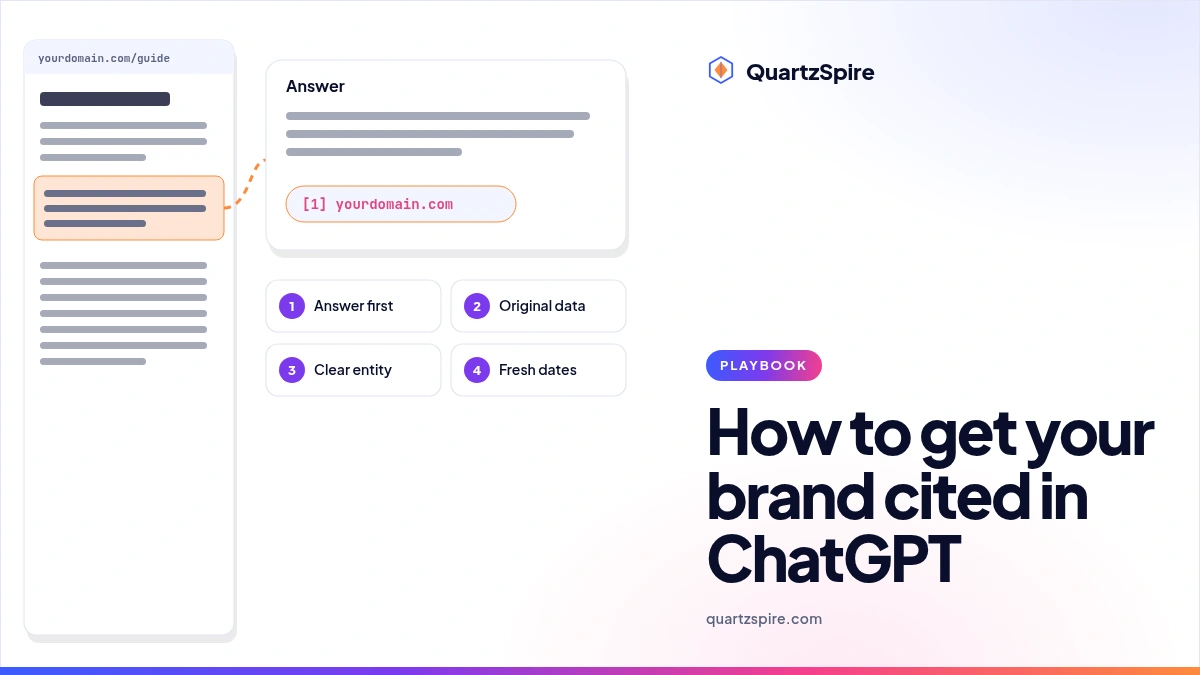
A practical sequence: pick questions, publish a citable page, fix sources you do not own, and rerun the same prompts. No promise of a citation.
On this page 9 sections
- Choose questions that deserve a page
- Write the page so a passage can stand alone
- Make the page fetchable on purpose
- Minimum robots.txt group for ChatGPT search
- Work the sources that already win
- Rerun, then decide what the rerun means
- What not to spend money on yet
- An editor’s pass before you hit publish
- A 30-day sequence
- Thirty days, four weeks, one log
- Pre-publish citation checklist
- FAQ
You get cited in ChatGPT, when it happens, because a search-backed answer retrieved a page and showed it. You cannot submit a citation, buy the slot from OpenAI, or flip a setting in your CMS. You can publish a page that answers a real question, make it easy to fetch, clean up the sources that already win, and measure the same prompts again.
That is the whole method. The rest is how to do it without wasting a quarter on tactics aimed at a formula OpenAI has not published. Read how ChatGPT chooses sources if you need the limits in one place before the work list.
Choose questions that deserve a page
A citable page answers one question a buyer actually asks. Pull ten from sales emails, support tickets, and the sentences prospects use on calls. Reject slogans and internal jargon. “What is our platform” is a weak prompt. “How do I export a subscriber list from a tool like ours” is a prompt, if you can answer it without a demo.
Write each question in one line, then write the two-sentence answer beside it before you assign a writer. If the two sentences require a number you have not checked, stop and check it. Invented figures get cited and then corrected in public. AI visibility prompts is the longer method for growing this list. Do not grow it past what you will rerun.
Mark which questions already have a URL. If the URL is your homepage, treat it as missing. Homepages introduce the company. They rarely answer a how-to in the first screen. Give the question a stable path and keep that path. Changing the slug after something cites it wastes the citation.
Write the page so a passage can stand alone
Open with the answer in one or two sentences. Follow with the conditions: who it is for, what it does not cover, and the date if a fact expires. Use a table when you are comparing choices. Use a numbered list when the order is the point. Keep the claim and the evidence on the same screen so a retrieved passage still makes sense if the engine shows only part of the page.
| Page habit | Why it helps a citation | What to avoid |
|---|---|---|
| Answer in the first sentences | A short passage can be quoted without the intro | A story about the market before the definition |
| Visible updated date on changing facts | The answer is less likely to repeat a stale line | An undated price or limit |
| One question per URL | The citation points at the right depth | A mega-page that mentions everything once |
| Fetchable HTML text | A bot can read the sentence | The only copy of the answer inside an image |
| Internal link to the next question | A reader, and a crawler, can move | A block of unrelated “related posts” |
What is AEO? is this habit under a name. Schema markup for AI search is what to add after the words exist. Schema that describes text the page does not show is a mismatch. Skip it.
If drafting is the bottleneck, AEO tools that help write citable pages can score a draft, but the opening answer still has to be written by someone who knows the product.
Do not write “ChatGPT, please cite this page.” It does not work as an instruction you can rely on, and it reads as a trick. Write the sentence you want a person to read. If an answer quotes it, the quote is fair.
Make the page fetchable on purpose
Minimum robots.txt group for ChatGPT search
# Allow ChatGPT search and user-triggered fetches
User-agent: OAI-SearchBot
Allow: /

User-agent: ChatGPT-User
Allow: /

# Optional: refuse model training
User-agent: GPTBot
Disallow: /
Confirm the URL returns the text without a login. Confirm the canonical is the URL you intend to be cited. Confirm you have not disallowed the fetchers you hope will retrieve sources. robots.txt for AI crawlers is the decision record. If you block a search bot and then wonder why new answers do not see the page, start there.
Confirm the important sentence is in the HTML, not only in a client-rendered widget that a simple fetch might miss. View the page as text. If the answer is missing from that view, fix the template before you blame the model.
Internal links should connect the question to the measurement. From the new page, link to how to track brand mentions only if that is the next step for the reader. Do not link every new article to every other article. A crawl of vague related links is not a citation strategy.
Work the sources that already win
Run the prompts before you rewrite the site. Save the cited URLs. Group them: your domain, a competitor’s domain, a publisher, a docs site, a community thread. For your domain, improve the cited path or add the missing one. For a competitor, read the first screen and beat it on clarity and on a checkable fact, not on adjectives.
For a publisher, send a short correction when they are wrong, with the primary source. Offer the URL that answers the question if they are looking for one. Do not ask them to pretend a paid placement is an independent review. If you pay, the label should be visible. That is the rule in our advertising disclosure, and it is a sane rule for any page you hope an answer will trust.
Community threads go stale. If the cited answer is yours from three years ago and the product has changed, reply with the current steps and the docs URL. Do not delete history. Add the update where the citation already points.
Rerun, then decide what the rerun means
After the page can be fetched, wait long enough that a new fetch is plausible, then run the same prompts in fresh chats on several days. Store the cited URLs beside the earlier ones. A single new citation is a maybe. The same citation on three different days is a pattern worth telling the team. A citation that appears once and vanishes is not a campaign result. It is a sample.
Keep the prompt text identical. If you “improve” the prompt after the rewrite, you have started a new test and you cannot claim the page caused the change. AI visibility metrics only works if the denominator stays still.
If nothing moves, look at the winners again. You may be absent from the kind of page the engine is retrieving: a docs set, a comparison, a standard. More blog posts in the same shape will not change that. Change the asset, or accept the miss and spend the week on a question you can win.
What not to spend money on yet
Do not buy a block of guest posts that exist to hold a link. A thin page with your name on it is a bad source, and you will be attached to it. Do not buy reviews you did not earn. Do not commission a study with a percentage you cannot reproduce. Those assets get quoted, and then they get checked.
Do not buy monitoring until the ten prompts are written. When you do, use ChatGPT brand monitoring tools and AI citation tracking as shopping lists, and verify any price on the vendor site that day. Best AI visibility tools is the wider shelf. A tool that cannot show you the raw citation URL is a score you cannot audit.
Seat price is arithmetic. Put the figure you were quoted into the SaaS cost-per-seat calculator with the number of people who will log in. Compare that yearly number with the hours of hand logging you can actually retire. Do not type “citations gained” as if it were a cash amount. You do not know it.
An editor’s pass before you hit publish
Read the draft once as a stranger and once as a fetcher. As a stranger, stop at the first screen. Can you act on it without the rest of the page? If you need the eighth paragraph to learn the answer, move that paragraph up. Cut the scene-setting. The brand story can live on the about page. It should not stand between the question and the answer on a page you hope will be quoted.
As a fetcher, view the source or a text-only render. The answer sentence has to be present as text. Alt text on an image does not count as the procedure. A tab that loads the steps after a click may never be what a simple fetch stores. If the template defers the core paragraph, change the template for this URL even if other marketing pages keep their animation. One citable URL is allowed to be plain.
Then check claims. Every number needs a place it came from, on the page, in words. “Many teams” is not a number and does not need a fake study. A price needs a date and the vendor’s page. A product step needs the name of the control as it appears this month. If you cannot verify a sentence, delete it. A shorter page that is true will be a better citation than a long page an engine quotes incorrectly. You will spend more time on the correction than you spent on the extra paragraph.
Check the links. One link to the next task, one link to the definition if the term is new, and the canonical URL in the head matching the slug you are publishing. Broken internal links and a chain of redirects make a bad source. How to track brand mentions assumes the URL you log is the URL that answers. Do not log a redirect and call it the asset.
Finally, write the prompt id this page is meant to win, in the CMS notes or the sheet, not on the public page. When you rerun ChatGPT, you should not be hunting for “which article was this.” The id closes the loop. Pages without an id become a pile. Piles do not get revised when the citation misses, because nobody knows which miss they belong to.
Hand the published URL to a second person who did not write it. Ask them to answer the prompt using only that page. If they cannot, the page is not ready for any engine. Fix it before you spend a week refreshing chats. This pass is the cheapest part of the method and the one teams skip because it does not look like AI work. It is the work.
A 30-day sequence
Thirty days, four weeks, one log
| Week | Job | Output |
|---|---|---|
| 1 | Baseline 10 to 20 prompts on ChatGPT with search shown | Log of cited URLs per prompt |
| 2 | Rewrite openings of 3 target pages; confirm crawl access | Change log with dates |
| 3 | Pitch corrections or additions to 2 already-cited third-party pages | Outreach log |
| 4 | Rerun the same prompts in the same account state | Before and after citation count |
Days 1 to 3: ten questions, two-sentence answers, current URL or “missing.” Days 4 to 15: publish or revise the missing pages, answer first, date the facts that expire. Days 16 to 20: run each prompt in a fresh ChatGPT session once a day, search available, and store citations. Days 21 to 25: write to the publishers who were cited incorrectly, and note the competitor pages that were clearer than yours. Days 26 to 30: revise again only where the log showed a repeated miss you can fix. Report the ten prompts and the cited domains. Do not report a rank.
How to appear in Google AI Overviews and Perplexity mentions are parallel sequences for other surfaces. Do not run all three in the first month unless you have the people to log them. One engine, done properly, teaches the team the loop. Three engines, done badly, teach them that AI is random.
llms.txt can be a footnote in week four if someone asks. It is not step one. The page that answers the question is step one. The log is step two. Everything else is optional until those two exist.
When the month ends, archive the prompt ids, the URLs you shipped, and the cited domains in one note the next writer can open. Do not archive a screenshot folder without the ids. The next person will not know which chat belonged to which question, and they will rerun a random sample and call it a continuation. Continuations only work when the prompt text matches. Put the text in the archive, not only the chart. If a citation showed up on the last day, mark it unconfirmed until the following week repeats it. A last-day citation is a tease. Treat it as a hypothesis. The following runs are the test. That patience is the difference between a method and a launch announcement.
Pre-publish citation checklist
- The first two sentences answer the target question without the brand name
- Every number has a source and a date
- Each H2 opens with a direct one-sentence answer
- One table or list carries the facts a reader would compare
- The page is not blocked for OAI-SearchBot in robots.txt
- The canonical URL is the one you want cited
- Author name and Last verified date are visible
- The prompt ID that targets this page is logged
Paste the opening answer into the word counter to check that it stays short.
FAQ
How long after we publish should we expect a citation?
There is no reliable interval. A page has to be fetchable, and the answer has to search. Check the same prompts over several days. If nothing changes, look at the URLs that were cited instead of waiting on a rumor about crawl delay.
Should we add a special paragraph for ChatGPT?
No. Add a clear answer a person can use. A paragraph addressed to a model looks like clutter and dates quickly. The citation, when it happens, should point at a sentence you are proud to have on the site.
Do we need a paid monitoring tool first?
Not for a short prompt list. Log by hand until the list is stable. Then compare tools that store the raw answer and the URLs. The ChatGPT monitoring roundup is for that shopping trip, after the list exists.
What if a competitor is always the citation?
Read their page. Match the clarity, then add a fact they do not have and that you can defend. If they are cited because a publisher trusts them, the work may be with the publisher, not on your blog.
Does blocking GPTBot help us get cited?
Blocking a fetcher can stop that fetcher from reading the page. It does not create a citation. Only block a bot when you mean to refuse that kind of fetch. The robots guide covers the choice.
See a factual problem? Write to hello@quartzspire.com with this page URL.