 Profound Custom quote
 Peec AI $95/mo
 Otterly.AI EUR 29/mo
 Scrunch $250/mo
 AthenaHQ $295/mo
 Semrush AI Toolkit $99/mo
 Ahrefs Brand Radar $50/mo
 SE Ranking $129/mo
 Rankscale EUR 99/mo
 Promptwatch $95/mo
 Goodie $295/mo
 Evertune $60/mo
AI Visibility
How to get mentioned in Perplexity answers
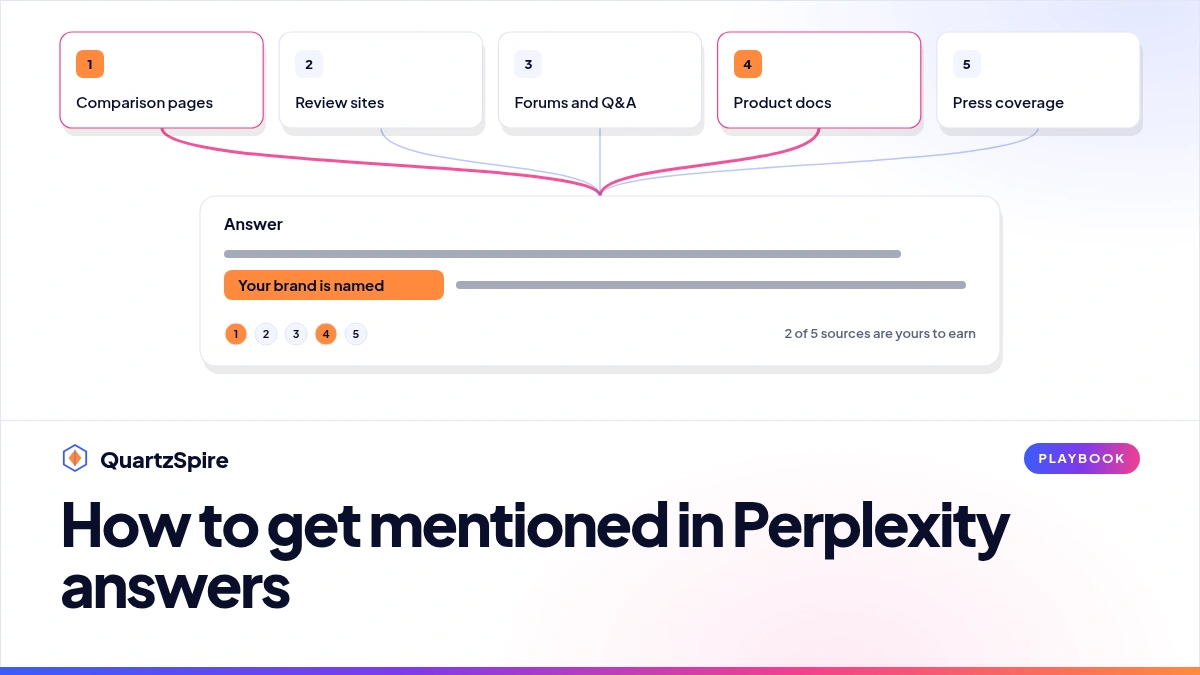
Perplexity shows answers with citations. You can earn a mention or a citation only by being a useful retrieved source, then checking the same prompts.
On this page 9 sections
- Say what you are counting
- Mention vs citation on Perplexity
- Run Perplexity like a test, not like a browse
- Build the page Perplexity would be right to cite
- Read the citations before you rewrite the blog
- What will not produce a mention
- When the log is long enough for a tool
- What to do with a source list on a Wednesday
- Source triage table
- Action key for a repeated domain
- Unstable prompts and when a tool earns its place
- A month on this engine alone
- Four-week Perplexity plan
- FAQ
You get mentioned in Perplexity when an answer names your brand. You get cited when the answer points at a URL. Perplexity is built to search and to show sources, which makes the citations easier to see than in a chat that only sometimes browses. It does not make them yours to assign.
There is no public queue where you submit a brand for inclusion. The work is the same shape as the other engines on this site: questions, pages, the sources that already win, and a log. The product is different, so the log gets its own rows.
Say what you are counting
Mention vs citation on Perplexity
Mention: the answer text names your brand. Citation: the answer links a URL on your domain.
Mention rate = answers naming you / answers logged Citation rate = answers linking your domain / answers logged
A citation without a mention is common on Perplexity. Log both.
A mention is your brand string in the answer text. A citation is your URL in the source list. You want both, and you will not always get them together. An answer can describe your category, cite a review, and never type your name. An answer can type your name because a cited page did, and link only to that page.
Split the columns. What is AI visibility? defines them. If a tool offers one Perplexity score, ask which column it is. A score that mixes mention and citation will move when either moves, and you will not know which fix to ship.
Also record whether the answer was useful. “Named us, described a feature we retired” is a mention you need to repair, not a win. The repair is a current page and, if a publisher repeated the old feature, a correction. Sentiment percentages can wait. A sentence in the note is enough.
Run Perplexity like a test, not like a browse
Pick ten prompts. Use a clean session. Set the location and language if the product exposes them, and write the settings down. Ask the prompt once. Copy the answer’s brand names and every source URL. Do not ask a follow-up and then count the follow-up as the same prompt. You changed the question.
Repeat on a schedule. Perplexity can change citations as its index changes. Three runs on three days beat one run you liked. How to track brand mentions is the sheet. Add a Perplexity section rather than a new philosophy.
Do not compare a Perplexity run to a ChatGPT run from a different day and call the gap a strategy failure. How ChatGPT chooses sources explains that product’s limits. The comparison you are allowed to make is: same prompt text, each engine logged on its own terms, same week.
Build the page Perplexity would be right to cite
Answer the prompt in the first two sentences. Name the thing. Say who it is for. Say the limit. Then prove it with steps or a table. Perplexity’s interface trains readers to look at sources. Your page should survive that look. If the source says less than the answer claimed, you have a problem even when the citation is yours.
| Prompt type | Page that can earn the citation | Weak substitute |
|---|---|---|
| What is X | A definition with a boundary | A homepage hero |
| How to X | Numbered steps and the failure case | A webinar with no transcript |
| X vs Y | A table of differences you can check | A paragraph of brand values |
| Pricing or limits | A dated figure from the vendor page | A roundup with no check date |
What is AEO? is the production standard behind that table. AI visibility tool pricing is how this site will handle money pages: vendor page first, check date visible, custom quote when the vendor will not publish a number. Do not feed Perplexity an undated price and then feel wronged when it repeats it.
One URL per question. If you publish a “Perplexity version” and a “human version,” you are asking retrieval to guess. Publish the human version. It is the only one you should want quoted.
Read the citations before you rewrite the blog
Export or paste the source list for each prompt. Count domains. You will often see review sites, docs, and comparison pages. That count is your editorial calendar.
If your docs lost to a third-party list, open the list. Maybe it answers in a table and your docs answer in a tour. Write the table into the docs. Maybe the list is paid and unlabeled. Decide whether that is a source you want an answer to trust. You cannot silent-edit someone else’s site. You can publish the primary page and ask for a correction where the list is false.
Best AI visibility tools and AI citation tracking tools are commercial pages in this category. Use them when you are choosing a recorder. Do not cite them as proof of a price unless the page shows the day the price was checked. This guide does not copy those prices.
Competitor docs that win are a gift. They show the outline your page lacked. Match the clarity. Add only what you can prove. Adjectives are not a difference a citation needs.
What will not produce a mention
A footer that says “cite us in Perplexity” will not. A block of hidden keywords will not. A fresh domain with ten thin posts will usually not, and it should not. Blocking crawlers while hoping for citations will not. robots.txt for AI crawlers is how to refuse a fetch on purpose. Refusal is the opposite of being retrieved.
llms.txt will not, by itself, put your name in an answer. Publish it only as a map of pages that are already good. Schema markup will not, by itself, either. Mark up the answer that is already visible.
Paying for a fake review will sometimes get a mention of the worst kind: a source that does not survive a click. If a reader opens the citation and finds a page that was bought and disguised, you lose the trust the citation was supposed to borrow. Paid placements on this site are labeled. Ask the same of anyone you pay.
When the log is long enough for a tool
Ten prompts, checked by hand for a month, are a complete education. After that, hand logging gets skipped and the sheet lies. That is the moment to look at software. Best AEO tools and the citation roundup above are the shelves. Ask each vendor to run your ten prompts and show the raw Perplexity sources, not a category score.
Before you buy, measure Perplexity referral traffic in GA4 so you know whether cited answers already send visits.
Put the yearly cost into the SaaS cost-per-seat calculator. Count seats as people who will open the tool, not as the whole company. If only one person will read the export, buy one seat or keep the sheet. The software ROI calculator is the same honesty test for hours. Hours you still spend checking the raw answers do not count as saved.
AI visibility prompts is how you grow past ten without adding junk. Metrics is how you turn the Perplexity rows into a rate. The rate’s denominator is your list, run on Perplexity, not “share of Perplexity.”
What to do with a source list on a Wednesday
Source triage table
| Cited source type | Who controls it | Action this week |
|---|---|---|
| Your own page | You | Tighten the opening answer and add a dated fact table |
| Vendor docs or partner page | Partner | Ask for a factual correction or a link |
| Review or comparison page | Publisher | Send verified pricing and a product note |
| Forum or community thread | Community | Answer helpfully under your real name; no astroturfing |
| News article | Newsroom | Pitch only when you have new, dated facts |
Open the ten source lists side by side. You are looking for repetition, not for a vibe. A domain that appears on one prompt is a sample. A domain that appears on six is a pattern for this list, this week. Write the pattern as a sentence: “For how-to prompts, docs from the vendor were cited. For comparison prompts, a review site was cited.” That sentence is allowed because you counted your ten. It is not a law about Perplexity. Next month’s ten can move. Say “this week” in the sentence so nobody promotes it to a rule of the internet.
For each repeated domain, assign one action. Your domain: name the path that should have been cited and the editor who will change the first screen. A competitor: note the heading structure and whether you are willing to publish an equally specific page. A publisher: if the page is accurate, no action, or a request to add a missing limit if you have the evidence. If the page is inaccurate, a correction email with the primary URL, sent by a person, not a spray of outreach. Track whether they replied. A sent email is not a result. A changed sentence is.
Action key for a repeated domain
- Your domain: name the page that should have been cited and the editor who owns it.
- Competitor: note the heading structure, then decide whether to publish an equally specific page.
- Accurate publisher: no action, or ask to add a missing limit you can evidence.
- Inaccurate publisher: one correction email from a person, with the primary URL attached.
Do this on Wednesday so Thursday can be writing and the next week’s run is not the same broken page. Teams that “review the AI report” on Friday and rewrite nothing will collect the same sources forever and call it monitoring. Monitoring without an action column is a scrapbook. Add the action column even if the action is “none, the source is fair.”
Keep a separate note for sources that are thin or deceptive. If Perplexity cited a page that exists to sell links, do not try to imitate it. Publish the primary answer and, if you have a factual correction, send that. Imitating a thin page trains your site to be a bad source the next time a reader clicks. What is AEO? is the standard you are holding yourself to, including when the citation you lost was easier and worse.
Unstable prompts and when a tool earns its place
If the same prompt cites a different set every run, write “unstable” and do not rebuild the site around one of the sets. Unstable prompts are a reason to keep the sample large, or to drop the prompt if it is not important. They are not a reason to panic-publish. How to track brand mentions tells you how to mark a row so an unstable prompt does not get averaged into a calm chart. Use that mark. A calm chart of an unstable prompt is the chart that will embarrass you when someone reruns it live in a meeting.
When the Wednesday review is dull, you are ready for a tool to store the lists. Dull means the columns are filled and the actions are small. That is success. Exciting reviews usually mean the sheet is new or the answers are wrong. Do not buy software to make the review exciting. Buy it to keep a dull review from being skipped. The roundups at best AI visibility tools and best AEO tools are for that moment, with prices checked on the vendor’s own page.
A month on this engine alone
Four-week Perplexity plan
- 01Week 1Log 15 prompts with all cited sources; confirm PerplexityBot is allowed.
- 02Week 2Fix the two own pages closest to being cited.
- 03Week 3Work the three third-party sources cited most often.
- 04Week 4Rerun all 15 prompts and report mentions and citations in separate columns.
Week one: ten prompts and the definition of mention versus citation, agreed in writing. Week two: run them, store sources, group domains. Week three: fix the two pages where you were the wrong URL or absent and the winner was simply clearer. Send corrections where a cited page is false. Week four: rerun. Report mentions, citations, and the domains that still win. Do not report a Perplexity rank. There is not one you can verify.
Google AI Overviews can be month two. Doing both at once with the same person usually means both logs go stale. Stale logs are worse than a narrow one, because the team starts quoting them.
Protect the hour. Put the Perplexity run on the calendar as a meeting with yourself, and do not accept a demo in that block. The run is the asset. A demo can move. If you miss a week, leave the rows blank and say the week was missed. Do not backfill from memory. Memory smooths the citations into whatever you hoped. Blank rows are ugly and accurate. Accurate is what you will wish you had when a citation you remember cannot be found.
Share the Wednesday domain list with the writer in the same doc as the prompt ids. A separate slide will drift. The writer should see the URL that won next to the id their page is supposed to serve. If those two are not on one screen, the rewrite will aim at a general improvement and miss the passage that was actually cited. General improvements are how blogs grow without changing the answer. This program is trying to change the answer, or to accept that it did not change. Both outcomes need the id and the URL in the same glance.
When a prompt is unstable for three weeks, decide in writing to keep it or drop it. Keeping it means you accept a noisy row and you will not cite that row in a board note. Dropping it means you stop paying attention. Either decision is fine. Silence is how the noisy row becomes the anecdote everyone repeats. Write the decision under the prompt id and date it. Future you will not remember why the chart skipped a question, and you will be tempted to call the skip a bug. It was a choice. Record the choice.
FAQ
Is Perplexity the same as ChatGPT search?
No. They are different products. A citation in one is not a citation in the other. Keep separate rows in the log. The ChatGPT source guide does not transfer its screenshots to this one.
Can we pay Perplexity to be mentioned?
This guide does not describe a paid inclusion program, and you should not assume one from a rumor. If a salesperson offers a placement, ask what the label looks like to a reader. Hidden payment is a bad source.
Why does Perplexity cite a listicle instead of our docs?
Because that page answered the prompt in a way the retrieval kept. Open it. If your docs bury the answer, fix the docs. If the listicle is wrong, send a correction. Do not assume docs 'should' win.
How many prompts do we need?
Ten real questions will teach you more than a hundred keyword fragments. Expand only when you can rerun the full list. The prompt guide covers the rules for adding one.
Which tracker should we buy?
None, until the ten exist. Then use the AI visibility and citation roundups as a shelf, and check every price on the vendor site. A spreadsheet is a valid tracker at this size.
See a factual problem? Write to hello@quartzspire.com with this page URL.