 Profound Custom quote
 Peec AI $95/mo
 Otterly.AI EUR 29/mo
 Scrunch $250/mo
 AthenaHQ $295/mo
 Semrush AI Toolkit $99/mo
 Ahrefs Brand Radar $50/mo
 SE Ranking $129/mo
 Rankscale EUR 99/mo
 Promptwatch $95/mo
 Goodie $295/mo
 Evertune $60/mo
AI Visibility
llms.txt explained: what it does and whether you need one
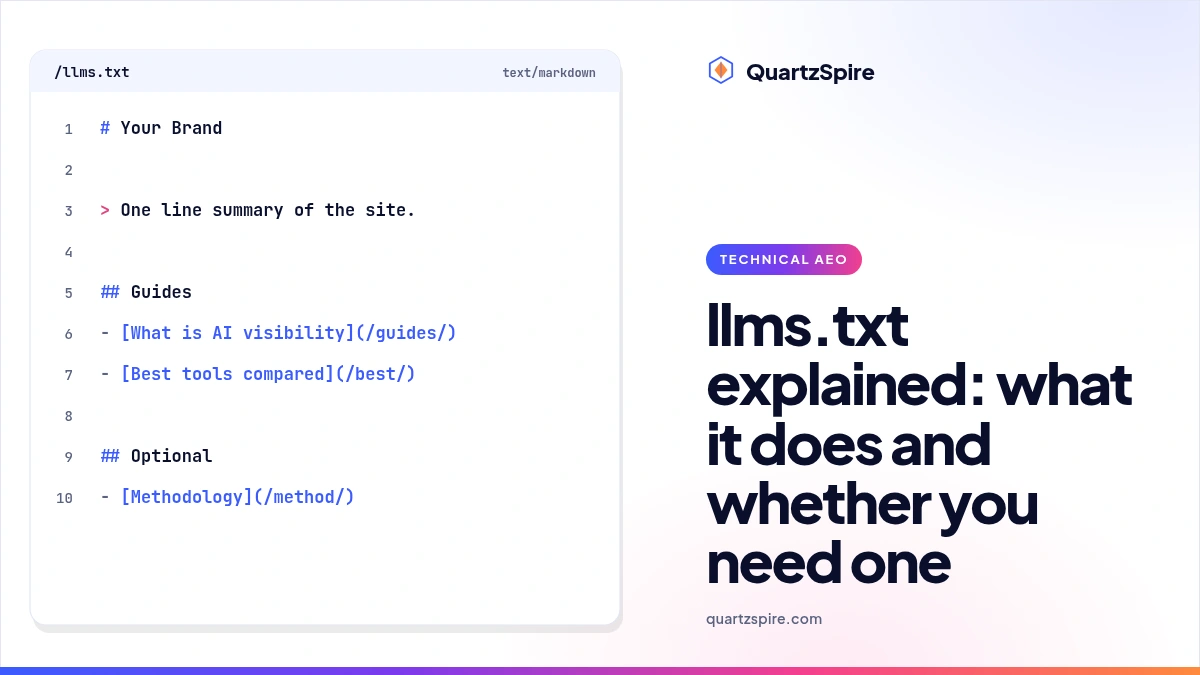
llms.txt is a proposed Markdown file at your site root that lists pages for language models. It is not a ranking switch.
On this page 8 sections
llms.txt is a proposed plain-text file, written in Markdown, that a site can publish at its root so an agent can see a short, curated list of important URLs and what each one is for. It is a map you maintain. It is not a setting that inserts your brand into ChatGPT, Perplexity, or Google AI Overviews.
You need one only if you will keep that map honest. You do not need one to be indexed, to rank, or to be cited. Those still depend on fetchable pages and on whatever the engine retrieves. robots.txt for AI crawlers is the file that allows or blocks fetches. This file does not.
What the proposal actually specifies
The proposal, published as a community spec rather than as a standard from a browser vendor or from an answer engine, describes a Markdown document with a fixed shape.
The first line is a level-one heading: the name of the site or project. After that, a blockquote holds a short summary. Optional paragraphs can add detail, but the file is meant to stay short enough to read. Then level-two headings group links. Each link is a list item: the title, the absolute URL, and a colon followed by a note. An optional companion file, often called llms-full.txt, can hold longer text. The short file is the index. The long file is optional and easy to neglect.
That is the whole structure. There is no required key for “rank,” no field for “cite this brand,” and no authentication. Anything that claims otherwise is adding a private convention. If you add private keys, agents that follow the proposal will not know them.
A minimal file looks like this. The URLs are examples of shape. Use your own.
# Example Site
> Example Site publishes guides and tools. This file lists the pages worth reading first.

This file is a map. It is not a complete dump of the site.

## Guides
- [What is AI visibility?](https://example.com/guides/ai-visibility/what-is-ai-visibility/): Definition, mention versus citation, and what to log
- [AI visibility metrics](https://example.com/guides/ai-visibility/ai-visibility-metrics/): Formulas for mention rate, citation rate, and share of voice

## Tools
- [Software ROI calculator](https://example.com/tools/software-roi/): Arithmetic for a yearly cost against hours you type

## Optional
- [Longer export](https://example.com/llms-full.txt): Only if you publish and maintain a full text file
Notes after the colon should say what the page decides, not a slogan. “Unlock growth” is useless to an agent and to a human. “Formulas for mention rate and citation rate” tells a reader whether to open the URL.
What it does not do
llms.txt vs robots.txt vs sitemap.xml
| File | Purpose | Controls crawling? | Format |
|---|---|---|---|
| robots.txt | Allow or refuse agents by path | Yes, for cooperating bots | Plain text directives |
| sitemap.xml | List every indexable URL | No | XML |
| llms.txt | Curated list of key URLs with notes | No | Markdown |
It does not override robots.txt. A bot that you disallowed does not become allowed because a link appears here. It does not replace an XML sitemap. Sitemaps are for discovery of many URLs. This file is a short reading list. It does not set your canonical URL. The canonical tag on the page does that. It does not mark a page up with types. Schema markup for AI search is that job, and only where the visible text matches.
It does not measure visibility. AI visibility metrics needs a prompt log. A file on your server cannot tell you whether Perplexity cited you on Tuesday. How to track your brand remains the measurement. If someone proposes llms.txt as the AI strategy, they have skipped the log.
It does not have a published guarantee from the major answer products that they read it before they answer. Some tools and agents may fetch it. Others will ignore it. Treat adoption as unknown unless you have watched a specific product request the file. Do not quote a percentage of engines. You do not have that census, and this page will not invent one.
When it is worth publishing
Publish it when three things are true. You can name fewer than a few dozen URLs that are the best entry points. Those URLs answer a question in the first screen, so you are not ashamed to hand them to a stranger. Someone owns the file and will edit it in the same week a URL is renamed or retired.
A good first version for a site like this lists the definitions, the how-to pages, and the tools, not every tag archive. What is AI visibility? and what is AEO? belong on that list because they define terms. A tag page with two posts does not.
Skip it when the site is changing every day and nobody will update the links. A stale llms.txt sends an agent to a 404 or to an old price. That is worse than silence, because you offered the map. Skip it when you want it to do robots.txt’s job. It will not. Skip it when the motive is “a thread said it boosts ChatGPT.” How ChatGPT chooses sources does not include this file as a weight, because no such weight has been published.
How to write the notes
A minimal llms.txt
# QuartzSpire

> Independent research on AI visibility and AEO software. Prices are checked on vendor pages and dated.

## Guides
- [What is AI visibility?](https://quartzspire.com/guides/ai-visibility/what-is-ai-visibility/): definition and measurement basics
- [AI visibility tool pricing](https://quartzspire.com/guides/ai-visibility/ai-visibility-tool-pricing/): pricing meters with dated examples

## Comparisons
- [Best AI visibility tools](https://quartzspire.com/guides/ai-visibility/best-ai-visibility-tools/): twelve tools, prices checked 24 Nov 2026

## Optional
- [Methodology](https://quartzspire.com/methodology/): how we check prices
Each note is one clause. Say the task the page completes. “Steps to log mentions and citations” is a note. “Amazing framework for modern teams” is not. Match the note to the H1 of the page. If the note and the H1 disagree, the file is lying.
Use absolute URLs with the trailing slash your canonicals use, so you do not list a second URL that redirects. Relative links are easier to get wrong when a tool fetches the file from the root. Absolute links are boring and clear.
Do not list paid placements as if they were editorial pages without saying so. If a URL is an ad, the note can say “paid placement” or you can leave it off the map. A curated file that hides payment is a bad introduction to the site. The advertising disclosure is the rule for pages. The same honesty belongs in a file you claim is a guide for agents.
Group with H2s that a person can scan: Guides, Tools, Policy. Do not invent a taxonomy of twenty headings for twelve links. The file should be shorter than the smallest guide it points at.
Keeping it true
Put the file in the same review as sitemap changes. When a guide is renamed, update both. When a guide is retired, remove the line. When you add a guide, add a line only if it belongs in the short list. Not every new URL earns a place. The bias should be toward fewer links.
Check the file the way you check a nav. Fetch it. Click each URL. Confirm the status is 200 and the H1 matches the note. A quarterly check is enough if the site is calm. A weekly check is required if you publish daily. Write the check date in your own log, not necessarily in the file. The proposal does not require a date field. Your operations doc can have one.
If you also publish llms-full.txt, generate it. Do not hand-copy ten articles into a text file. Hand copies rot. A generated file can be wrong too, if the generator includes drafts. Exclude sample and draft pages. QuartzSpire already keeps sample guides out of the sitemap. A full-text dump should use the same filter.
A review checklist before the file is public
llms.txt review checklist
- Every URL returns HTTP 200 and is canonical
- Every note is one plain sentence with no marketing claims
- No URL is blocked in robots.txt
- The file is served at /llms.txt as text
- A dated owner note says who updates it and when
Fetch the URL at the root and confirm the status is 200 and the type is text, not an HTML error page with a 200 you did not intend. Some hosts rewrite missing files to the homepage. A homepage served as llms.txt is worse than a 404, because an agent that trusts the proposal will read your marketing page as the index. Test with a client that does not follow your site’s pretty redirects, or compare the body hash to the file you think you deployed.
Read every list item aloud. Title, URL, note. If the note repeats the title, replace the note. If the URL has a tracking parameter, strip it. If the URL is http, or it omits the trailing slash your canonical uses, fix it so you are not advertising a duplicate. If the page is noindex, do not list it. You would be inviting a reader to a page you asked search engines not to keep. Sample and draft guides stay off the list for the same reason they stay off the sitemap.
Count the links. If you are over a few dozen, cut until each remaining link is one you would put in a welcome email to a new teammate. A welcome email is a fair editorial test. A sitemap is not. The sitemap can be large. This file should not be.
Confirm robots.txt does not disallow the file for the agents you hope might read it. A disallow of /llms.txt while you announce the file in a blog post is an accident. robots.txt for AI crawlers is the place to check the groups. The file can still be useless if those agents never request it. The checklist only prevents self-contradiction.
Store the source of llms.txt in the repository next to the pages, or generate it in the same build that writes the sitemap, from the same allowlist. A file edited only on the server will be overwritten, or it will survive a redesign that deletes the URLs. Generation from an allowlist is the durable version. Hand editing is acceptable for a dozen links if the deploy copies the file on purpose. Accidental omission is the failure mode. Add a build check that fails when a listed URL is not in the sitemap of indexable pages. That check is a few lines and it saves the quarterly embarrassment.
When the checklist passes, the file can go live. Mention it on the methodology or the docs index only if a human would use the map too. Hiding it is fine. It is a courtesy for agents, not a campaign. Do not add a banner. A banner is a popup you do not need, and this site does not use one for files or for analytics.
What to do instead if you skip the file
Answer the questions on real URLs. Make those URLs fetchable. Log whether answers cite them. That sequence does not need llms.txt at any step. How to get cited in ChatGPT and how to get mentioned in Perplexity never start with this file. They start with a page and a prompt.
If a buyer asks whether you “support llms.txt,” you can say you publish a short Markdown index at /llms.txt and that it is a map, not a promise of citation. That sentence is accurate. A sentence that says the file improves your rank is not, because you cannot show the mechanism.
Tools that crawl the file and score it are optional. Best AI visibility tools and best AEO tools are where product comparisons live. A score that only checks whether the file exists is a checklist item, not a visibility metric. Use the metrics page for rates. Use the software ROI calculator if someone wants to spend money on a product whose only job is to lint this file. The hours saved are the hours of clicking the links yourself. They are not hours of citations you have not measured.
If content production is the gap, compare GEO tools that pair writing with answer tracking instead of buying a file checker.
How to measure ChatGPT traffic in GA4 is the place for referrer traffic. llms.txt will not appear in that report. Do not look for it there.
If you do publish the file, link it once from a footer or a docs page as plain text, not as a modal and not as an interstitial. Readers who want the map can open it. Agents that look at the root can fetch it without your homepage mentioning it. Mentioning it is optional. Maintaining it is not optional once it is public. Assign the owner next to the sitemap owner so the two lists are reviewed together. When they disagree, the sitemap is the full indexable set and llms.txt is the short reading list. Disagreement is normal. A link on the short list that is absent from the sitemap is the disagreement to fix, because you recommended a URL you do not want indexed, or the sitemap is wrong. Fix that pair the same day. Leave the rest of the disagreement alone.
Paste the text into the character counter to check its length before you publish it. Paste the opening answer into the word counter to check that it stays short.
FAQ
Where does the file live?
The proposal puts it at https://example.com/llms.txt, beside robots.txt. A file in a subfolder with another name is a different file. Agents that look for the proposal will look at the root.
Is llms.txt the same as llms-full.txt?
No. llms.txt is the short curated index. llms-full.txt, if you publish it, is a longer dump of content. The proposal treats the long file as optional. Do not publish a dump you are not willing to keep current.
Will ChatGPT or Perplexity cite us if we add it?
Not by any rule those products have published as a guarantee. A citation still depends on retrieval and on the answer. Keep the prompt log. Treat llms.txt as a map, not as a vote.
Should the file list every URL?
No. A sitemap lists URLs for crawlers. llms.txt, as proposed, lists the pages you most want an agent to read, with a one-line note. A thousand-line file is a sitemap with extra punctuation.
Does it block or allow crawlers?
No. Allowing and blocking are robots.txt. llms.txt does not disallow a bot. Read the robots guide before you mix the two files in one project.
See a factual problem? Write to hello@quartzspire.com with this page URL.