 Profound Custom quote
 Peec AI $95/mo
 Otterly.AI EUR 29/mo
 Scrunch $250/mo
 AthenaHQ $295/mo
 Semrush AI Toolkit $99/mo
 Ahrefs Brand Radar $50/mo
 SE Ranking $129/mo
 Rankscale EUR 99/mo
 Promptwatch $95/mo
 Goodie $295/mo
 Evertune $60/mo
AI Visibility
What is AI visibility? A plain guide for marketing teams
AI visibility is whether answer engines name your brand and cite your pages. This guide shows what to record before you buy a tracker.
On this page 10 sections
- What the phrase means in a marketing meeting
- A mention and a citation are different events
- Mention vs citation
- Which surfaces belong on the list
- What a tracking sheet has to contain
- How a week of measurement runs
- One measurement week
- What breaks the measurement
- How this sits next to AEO and SEO
- Who owns the sheet
- Ownership map
- When a tool is worth paying for
- FAQ
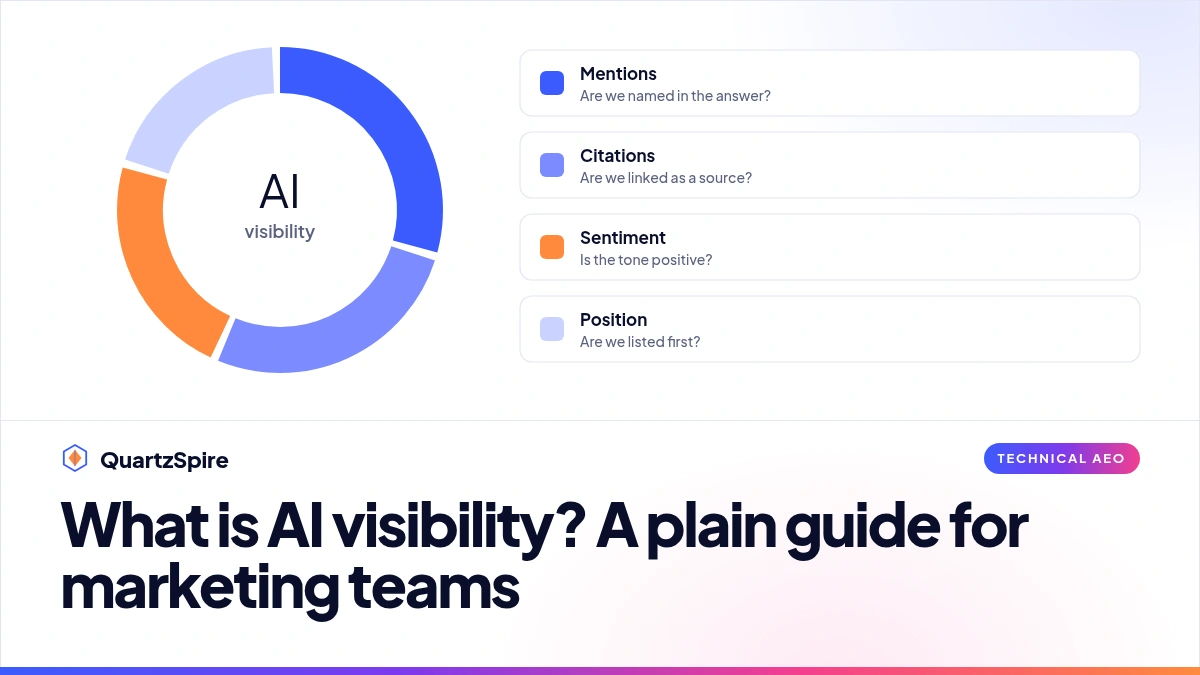
AI visibility is whether an answer engine names your brand, or cites one of your pages, when a person asks a question. It is a record of those events, not a score the engine publishes.
A marketing team can watch it the same way it watches any other channel it does not control: fix the questions, repeat them, and write down what the answer said. The rest of this guide is that workflow, without a vendor pitch.
What the phrase means in a marketing meeting
AI visibility means a buyer can meet your name inside an answer, not only in a list of links. The answer might be a ChatGPT reply that searched the web, a Perplexity answer with citations beside it, a Google AI Overview above the classic results, or a similar box in another product. If the brand is named, that is a mention. If a URL on your domain is shown as a source, that is a citation. Both matter, and they are not the same event.
Treat the phrase as an observation, not as a rank. Nobody outside the engine company has the formula that chose those sentences. What you have is the output: the words on the screen, the links under them, and the conditions of the session. How ChatGPT chooses which websites to cite walks through the public parts of one engine. The same limit applies everywhere. You can see the answer. You cannot see the score.
Use plain language with the rest of the company. “We were cited on three of ten prompts this week” is a fact you can check. “Our AI visibility score is 72” is not, unless you also say which prompts, which engine, which day, and how the number was built. Most vendor scores are a summary of a prompt set the customer defined, or a prompt set the vendor suggested. Ask which one you are looking at before you put the number in a deck.
A mention and a citation are different events
Mention vs citation
| n/a | Mention | Citation |
|---|---|---|
| What appears | Brand name in answer text | Link to a URL on your domain |
| Can happen without the other | Yes | Yes |
| Metric | Mention rate | Citation rate |
| Main lever | Third-party sources and brand clarity | Page quality and crawl access |
| Logged as | named = yes | cited_own_url = path |
A mention is the brand string appearing in the answer text. A citation is a link, a domain, or a source card pointing at a page. An answer can mention you and cite a review site. An answer can cite your documentation and never say the brand name in the paragraph. An answer can do both, or neither, and recommend a competitor instead.
Record them in separate columns. If you collapse them into one “visibility” tick, you will not know whether the work to do is on the page that should be cited, or on the way the brand is described in places the engine already trusts. Third-party pages, comparison articles, docs, and your own product pages all show up as citations. Note the domain, not only “yes, we appeared.”
Sentiment is a third column, and it is the easiest one to fake. Do not turn it into a percentage unless a person read the answer and applied a written rule. “Names a limitation” and “recommends against” are enough for a weekly log. A later page, AI visibility metrics, is where share of voice and citation rate should be defined as counts over a prompt set, not as industry benchmarks. Those counts are only as good as the prompt list.
Which surfaces belong on the list
Write the surfaces down before anyone runs a prompt. A useful first list for a software company is short:
| Surface | What you can record from the screen | What you should not pretend to know |
|---|---|---|
| ChatGPT with browsing or search | Whether the brand is named, which URLs are cited, and the date | The retrieval score, or why a rival was chosen |
| Perplexity | The answer text and the citations shown next to it | How often the index refreshes a given URL |
| Google AI Overviews | Whether an overview appeared, and which links it showed | That an overview will appear for that query tomorrow |
| Other answer boxes (Copilot, Gemini, and similar) | The same two events: mention and citation | That every product uses the same index |
You do not need every surface on day one. Pick the two a buyer on your team already uses. How to get mentioned in Perplexity answers and How to appear in Google AI Overviews cover two of those surfaces in more detail. Adding a third engine doubles the logging work. Add it when the first two are boring and reliable, not when a vendor demo shows a grid of logos.
Location and language are part of the surface. An overview in one country is not evidence about another. If you sell in one market, say so on the sheet. If you sell in several, the prompt list needs a location column or you will mix results and call the mix a trend.
What a tracking sheet has to contain
A minimum sheet has one row per prompt, per engine, per run. The columns that earn their keep are: the prompt text, the engine, the location, the date, whether the brand was named, the cited URLs, the competitors named, and a short note if the answer was wrong. That is enough to see a change. Extra columns for “share of model” or a 0 to 100 score can wait until the raw rows exist.
Keep the prompt text stable. If someone rewrites “best payroll software for a 40-person agency” into “top payroll tools” halfway through the month, the new row is a new question. Do not average them. How to build a prompt list for AI visibility tracking is the page for building that list without stuffing it with prompts nobody asks.
Store the sheet where the team can open it. A shared document is enough at ten prompts. A tracker is a database for the same columns once the combinations grow. The step-by-step tracking guide is the operating version of this sheet. Read that before you sit through a demo, so you can ask the vendor which of these columns they actually store.
How a week of measurement runs
One measurement week
- Monday: Run 20 frozen prompts on 3 engines from one location.
- Monday: Log named, cited URL, competitors, and a raw answer link per row.
- Tuesday: Tag sentiment on answers that name you.
- Wednesday: Compute mention rate, citation rate, and share of voice.
- Thursday: Turn misses into page or source tasks, not new prompts.
Monday, run the list once per engine, in a fresh session, signed out if the product allows it. Paste the answer and the citations into the sheet, or let the tool store them. Do not argue with the answer in the same session and then count a second reply. You changed the context.
Wednesday, repeat. Friday, repeat. At the end of the week, count three things only: prompts where you were named, prompts where your domain was cited, and prompts where a named competitor was cited and you were not. Those three counts are the weekly report. A paragraph of color is fine. A new composite score is not, until the team has agreed how it is calculated and has written that rule next to the chart.
Look at the misses as pages, not as a mood. If the cited URL is a rival’s docs and yours are thin on that question, the next task is a page that answers the question, not a prompt tweak. If the cited URL is a publisher you do not control, the next task might be a correction, a source the publisher can check, or a decision to leave it. How to get your brand cited in ChatGPT covers the page work. It will not promise a citation.
Once a month, read ten answers yourself even if a tool summarized them. Tools miss a brand string when the answer uses a product name you did not list, and they can mark a citation that is a footer link rather than a source the paragraph relied on. The monthly read is the audit of the tool, not a replacement for it.
What breaks the measurement
A single screenshot in Slack is not a trend. Personalization, tests, and cached answers make one session a sample of one. If leadership wants a number, give them the three weekly counts and the prompt list in an appendix. If they want a competitor “beaten,” show the prompts where the rival was cited and you were not, and the URL that was cited. That is a work list.
Do not block or allow crawlers as a substitute for this log. robots.txt for AI crawlers explains what a robots rule can and cannot do. A disallow line can stop a named bot from fetching a URL later. It does not erase a page already in an index, and it does not write your name into an answer.
Do not add a file to the site and call the measurement done. llms.txt explained is the short version: a proposed file is not a switch the engines have promised to obey. Ship the file only if you can say what a reader, human or machine, should do with it.
Do not invent a statistic for the board. If you did not count it on your prompt list, you do not have it. Public product posts from engine companies describe features. They are not a census of how often your category is answered.
How this sits next to AEO and SEO
Search engine optimization is the practice of making pages eligible and competitive in a ranked list of links. Answer engine optimization, covered in What is answer engine optimization (AEO)?, is the practice of making pages and third-party descriptions easy for an answer to use and to cite. Generative engine optimization is a label some teams use for the same effort. GEO vs AEO vs SEO separates the labels so a meeting does not spend an hour on vocabulary.
AI visibility is the measurement those practices are trying to move. You can do the page work and still be invisible on the prompts that pay the bills. You can be visible on a prompt you do not care about and absent on the one a sales engineer hears every week. The prompt list is how you tell those apart.
Schema markup, internal links, and clean headings help a parser. They are not a citation guarantee. Schema markup for AI search says what is worth marking up and what is wishful. Use it after the sheet exists, so you know which URLs are the ones answers already prefer.
Who owns the sheet
Ownership map
| Task | Owner | Cadence |
|---|---|---|
| Prompt list changes | SEO or content lead | Monthly review |
| Weekly runs | Analyst or assistant | Weekly |
| Sentiment tags | Second reviewer | Weekly |
| Page fixes | Content team | As logged |
| Tool decision | Marketing lead | Quarterly |
Name one owner. A shared sheet with no owner becomes a screenshot folder. The owner is not “the AI person” unless that person also has time to run the prompts. On a small team the owner is often a content lead or a product marketer who already writes the pages buyers read. Their job is the weekly count, the miss list, and a note when a prompt should be retired because nobody asks it.
Give a second person read access and a calendar hold once a month to sample ten answers. That second read is how you catch a brand string the sheet missed, or a citation that is a sitewide footer rather than a source. Do not form a committee. A committee will rename columns. The columns above are enough.
Sales and support hear the questions the prompt list should contain. Once a month, ask them for five questions from real calls. Add a question only if it is specific enough to answer with a page. “Are we good?” is not a prompt. “Which tool exports a subscriber list without a sales call?” is a prompt, if that is a deal you lose. Retire prompts that have not matched a real conversation in a quarter. A long list feels thorough and measures noise.
If an agency runs the sheet for you, keep the prompt list in your own document as well. You should be able to leave with the questions, the definitions of mention and citation, and the weekly counts. A login you cannot export is not an asset. Put that requirement in the statement of work before the first month, not after the score appears in a quarterly review.
When a tool is worth paying for
Pay for a recorder when hand logging breaks: more engines, more locations, more prompts, or a need to show the raw answer later. Do not pay for a recorder because the demo had a high number. Ask to see your own ten prompts in the product, on the engines you listed, and ask what happens when the answer has no citation. Then put the annual seat cost next to the hours you will stop spending. The software ROI calculator does that arithmetic from numbers you type. It is not a prediction that the tool will earn the citation.
The commercial roundups that compare recorders, including best AI visibility tools and best AEO tools, are the place for product names and for prices checked on a stated date. This page is the definition. If a price is not on the vendor’s page the day you look, write “custom quote” in your own notes. Do not borrow a figure from a roundup that does not show its check date.
If you want to test a recorder before asking for budget, the list of cheap and free AI visibility tools shows which ones offer a free tier or a no-card trial.
A last filter before you sign: can you export the prompt, the answer, the citations, and the date? If the only output is a score, you cannot audit it. Visibility you cannot open is a slide, not a measurement.
To turn a count into a rate, run it through the percentage calculator.
FAQ
Is AI visibility the same as SEO?
No. SEO is the work of earning a place in a search result list. AI visibility is whether an answer engine names you or cites a page when someone asks a question. The two overlap, because many answers are built from pages the engine retrieved, but a page can rank in classic search and still be absent from an answer.
Can a team measure AI visibility without a paid tool?
Yes, for a small prompt list. Ask the same prompts on a schedule, in a fresh session, and write down whether the brand was named and which URLs were cited. A paid tracker becomes useful when the prompt list, the engines, and the locations are too many to record by hand. The method is the same either way.
Does a mention count if the answer criticizes the brand?
Yes. A mention is the brand name appearing in the answer. Sentiment is a separate field. If you only count friendly mentions, you will miss answers that describe a limitation or a competitor comparison. Record the mention first, then note the tone in your own words.
Why do two people see different answers to the same prompt?
Answer engines personalize, test, and refresh results. Location, language, signed-in state, and the time of day can change which pages are retrieved. That is why a single screenshot is not a measurement. A measurement is the same prompt, repeated, with the conditions written down.
Where should a team start?
Start with ten prompts a buyer would actually type, on two engines you care about, in one location. Record mentions and citations for two weeks. Then decide whether a tool is worth the seat cost. The software ROI calculator on this site is only arithmetic for that decision, not a forecast.
See a factual problem? Write to hello@quartzspire.com with this page URL.