 Profound Custom quote
 Peec AI $95/mo
 Otterly.AI EUR 29/mo
 Scrunch $250/mo
 AthenaHQ $295/mo
 Semrush AI Toolkit $99/mo
 Ahrefs Brand Radar $50/mo
 SE Ranking $129/mo
 Rankscale EUR 99/mo
 Promptwatch $95/mo
 Goodie $295/mo
 Evertune $60/mo
AI Visibility
GEO vs AEO vs SEO: what is the difference?
SEO earns a place in a link list. AEO and GEO are labels for making pages usable and citable in generated answers. Here is how to brief the work.
On this page 9 sections
- Three outcomes, not three religions
- What stays true from SEO
- What people add when they say AEO or GEO
- How to brief a writer without the jargon fight
- What to measure in each column
- SEO, AEO, and GEO side by side
- A migration plan if the team is mid-argument
- One query, written out in both reports
- One query, three reports
- What to tell an agency
- Agency brief checklist
- FAQ
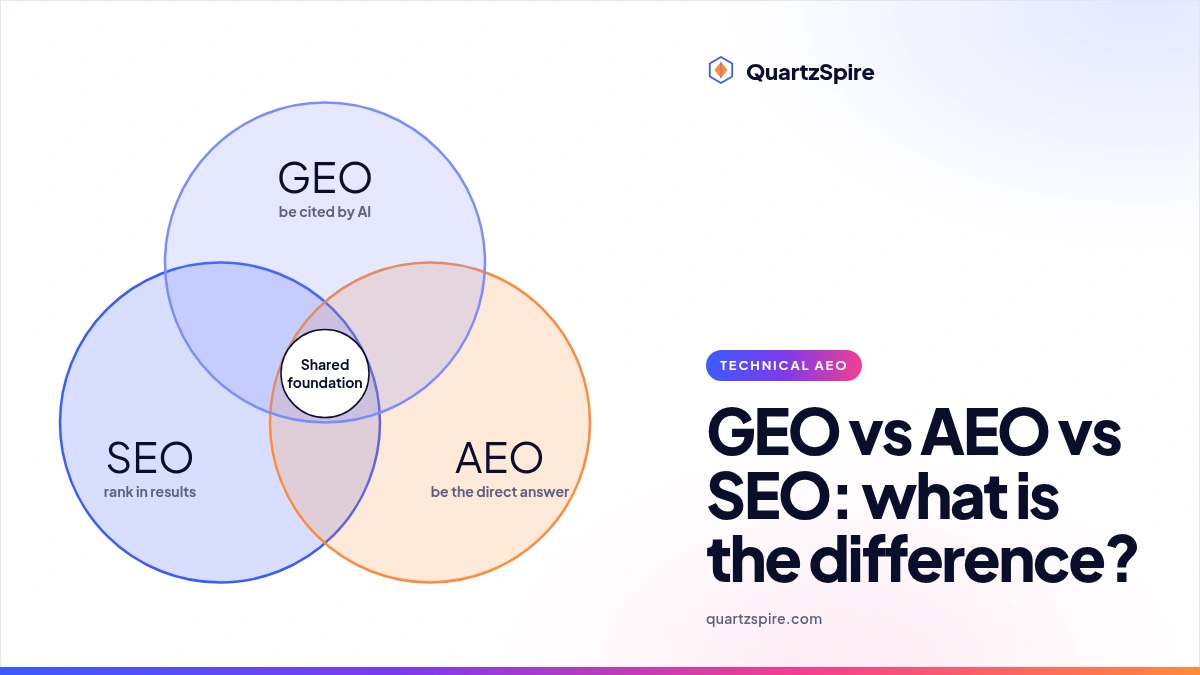
SEO is the work of earning a useful place in a list of links. AEO is the work of making a question answerable from a page worth citing. GEO is a label for that second effort when the product generating the answer is the thing you care about. The tasks overlap. The outcomes are not the same row on a report.
If a meeting is stuck on the acronym, write the deliverable instead. “Revise the export article so the first two sentences answer the question, then log ten prompts on two engines for four weeks.” That sentence is SEO and AEO and GEO at once. The acronym did not do any of the work.
Three outcomes, not three religions
A search result list and a generated answer fail in different ways. You can rank and never be quoted. You can be quoted from a page that ranks on page two. You can be named in the sentence while the citation goes to a reviewer. Those are three different fixes: a page that should rank, a page that should be the source, and a description on someone else’s site.
Put them in one table so the team stops treating them as synonyms.
| Label | Outcome you can check | Typical unit | What a miss looks like |
|---|---|---|---|
| SEO | A URL appears in a ranked list for a query | Query, URL, position, clicks | The page is missing, or it ranks and the click lands on the wrong screen |
| AEO | An answer cites a URL you trust for a question | Prompt, engine, cited URL | The answer cites a rival, a dead page, or nothing |
| GEO | Same as AEO, framed as generative engines | Prompt, engine, cited URL | Same miss, different slide title |
| AI visibility | The brand is named, the URL is cited, or both | Prompt, mention, citation | You cannot tell which of the two happened |
What is AI visibility? defines the last row. What is AEO? defines the work behind the second row. GEO does not get a separate process on this site unless the tasks diverge. If a vendor sells “GEO” as a different product from “AEO,” ask which column in the table their export fills. If both exports are a prompt log, you are buying one product with two names.
What stays true from SEO
Fetchability stays true. A page that returns an error, that blocks the bot you care about, or that hides the text in a canvas is a weak source. Titles, headings, and internal links still tell a crawler and a reader what the page is. Backlinks and mentions on other sites still function as descriptions you do not fully control. None of that was repealed because a chat box got popular.
What changes is the success test. A classic report can show impressions and clicks for a query. An answer may send fewer clicks and still shape the shortlist. You will not see that in the old report. You need the prompt log described in how to track your brand in AI search. Keep the old report. Add the new one. Do not average them.
Technical cleanup still pays. Canonical tags, one URL per page, and a sane robots.txt stop you from offering an engine five copies and a blocked copy. robots.txt for AI crawlers is the policy page. Schema markup for AI search is the markup page. Do those after the question list exists, so you mark up pages that match real prompts rather than every template on the site.
What people add when they say AEO or GEO
They add an answer-first page. The first sentences state the answer. The rest qualifies it. They add a habit of naming the question in the buyer’s words. They add a watch on citations, not only on rankings. They add a respect for third-party pages that already occupy the citation. How to get cited in ChatGPT is that habit for one engine. How to appear in Google AI Overviews is the same habit for overviews, which are still Google’s search system, not a separate internet.
Teams that want software for the citation watch can start with AEO tools compared on drafting and citation proof, then decide which half they are short on.
They also add humility about the formula. SEO has a long public record of what tends to correlate with rankings, and even that record is not the formula. Generated answers have a shorter public record. OpenAI, Google, and Perplexity publish product descriptions. They do not publish the weight on your H2. Anyone who quotes a weight is guessing. Say so in the brief. It keeps the next experiment honest.
How ChatGPT chooses sources and how to get mentioned in Perplexity are the engine notes. Read them before you copy a tactic from a thread. A tactic that depends on a button the product renamed last month is not a strategy.
How to brief a writer without the jargon fight
Give the writer the question, the reader, the fact to check, and the URL if one exists. Tell them the first two sentences must answer the question. Tell them which claim needs a date because it expires. Tell them which internal page to link next. Do not tell them to “sprinkle GEO.” They cannot sprinkle a label.
Example brief: “Question: how should a 15-person team track AI mentions without a tool. Reader: a marketing lead. Facts: the sheet columns we use, no vendor prices. Link: the tracking guide and the ROI calculator. Done when a stranger can run the sheet.”
That brief is SEO because the URL should be the one that ranks for the question. It is AEO because the answer is citable. It is GEO because a generative product might quote it. The writer did not need three sections of theory to start.
Review the draft by reading only the first screen. If the answer is missing, send it back. If the answer is there and the rest is proof, ship it. Long drafts that bury the answer train the team to write introductions. Introductions are where vague claims hide.
What to measure in each column
SEO, AEO, and GEO side by side
| n/a | SEO | AEO | GEO |
|---|---|---|---|
| Outcome | Ranked link and click | Direct answer taken from your page | Brand named or cited in a generated answer |
| Unit of work | Query and landing page | One question, one page | Prompt set across engines |
| Main metric | Rankings, clicks, impressions | Answer inclusion, citation rate | Mention rate, share of voice |
| Typical data source | Search console, rank tracker | Prompt log, SERP features | Multi-engine prompt log |
| Shared foundation | Crawlable, accurate, well-structured page | Same | Same |
For SEO, keep the query, the landing page, and the clicks you already believe. Do not invent a new rank score.
For answers, log the prompt, engine, date, mention, and cited URLs. AI visibility metrics defines rates as counts over that log. AI visibility prompts is how the list is built. A prompt list copied from a keyword export will measure keywords, not questions. Questions are full sentences a person would say.
For money, keep them apart as well. A ranking tool and an answer log do not have to come from the same vendor. Best AI rank tracking software is the commercial comparison for products that store this kind of log. Best AI visibility tools is the broader shelf. Check the price on the vendor’s site. If the page says “contact sales,” your note says custom quote. Do not fill the gap with a number from memory.
Seat cost is a spreadsheet problem. The SaaS cost-per-seat calculator multiplies the price you type by the seats you type. It will not tell you whether GEO or AEO is the better word. You already have this page for that.
A migration plan if the team is mid-argument
Week one, freeze the vocabulary. Pick AEO or GEO for internal docs, link this page, and move on. Week two, list ten questions and mark which already have a URL that answers them in the first screen. Week three, fix three URLs. Week four, run the prompts and file the log next to the SEO report, not inside it.
Refuse two projects during the month. Do not rewrite every title to include “AI.” Do not commission a 30-page market study full of percentages you did not count. Neither project produces a citation you can inspect.
If an executive asks which acronym wins, show the table and the log template. The work that changes the log is the work that wins. The other acronym can live on this page for anyone who searches it. That is also SEO. The page you are reading is how this site answers the comparison query without pretending the labels are different sciences.
One query, written out in both reports
One query, three reports
Query: “how to track brand mentions in AI search”
| Report | What the line says |
|---|---|
| SEO | Guide ranks in position 6 on Google; 140 clicks in 28 days (illustrative) |
| AEO | Google AI Overview shown; our guide is 1 of 4 cited sources |
| GEO | Named in 3 of 5 engines on the frozen prompt; cited in 2 |
One page, three outcomes. Report them in separate columns so a win in one does not hide a loss in another.
Take a query you already rank for and already care about. On the SEO side, write the URL that receives the click, the country, and whether the click lands on the answer or on a vague page. On the answer side, open the query where an overview can appear and run the same wording as a prompt in one chat product. Write whether an overview existed, which URLs it linked, whether the chat searched, and which URLs it cited. Four rows, one query. Do not summarize yet.
You will often find three different URLs. The ranking URL, the overview URL, and the chat citation are not required to match. That is the difference the acronyms are trying to name, and it is visible without a tool. If they do match, say that too. A team that only shares the surprising mismatches will think the channels never agree. They sometimes agree, and the page is doing both jobs.
Now assign the work from the mismatch, not from the label. If the ranking URL is a blog post and the overview cites docs, improve the docs or the internal link from the post to the docs, then check again later. If the chat cites a publisher, the SEO title tweak will not move that citation this week. Put the publisher in the off-site list. If nothing cites you and nothing ranks you, you do not have an AEO problem yet. You have a missing page. Publish the answer first. How to get cited in ChatGPT starts from that missing page. How to appear in Google AI Overviews starts from the overview column you just filled.
Repeat this for five queries before you adopt a new job title or a new agency scope. Five worked rows will end the argument faster than a glossary. Keep the rows. When someone later claims GEO “lifted” a keyword, you can see whether the overview link, the chat citation, or the classic click actually changed. If none of the three moved, the claim is a story. Stories are allowed in a retrospective. They are not a report.
Use the five rows to decide tooling too. If the pain is the classic URL, your current SEO reports may be enough. If the pain is the overview link, look at AI Overview tracking tools. If the pain is the chat citation, look at AI citation tracking. Buying the broadest suite because the acronym sounds broad is how the seat count grows. The SaaS cost-per-seat calculator should be open while you read the quote, with the real number of readers, not the size of the marketing alias.
What to tell an agency
Agency brief checklist
- Which outcome are we buying: ranking, answer inclusion, or brand mentions?
- Which prompt list and engines define success, and who owns the list?
- Which pages will change, and in what order?
- How will you separate mentions from citations in the report?
- What raw export do we receive each month?
Tell them the questions, the engines, the location, and the definition of a citation. Ask for the pages they will change and the log they will keep. Ask who owns the prompt list if you part ways. Pay for revisions and for the log. Do not pay for a renamed audit that hands you a score and no rows.
If they propose a tool, ask for an export of your ten prompts before the annual contract. Use the software ROI calculator with the hours they say the tool saves and the yearly cost on the order form. Hours they cannot point at in last month’s calendar are not an input. Leave them blank.
Best GEO tools will list products under the GEO label. Read it as a shelf, not as a decision. The decision is still the table at the top of this guide: which outcome is missing, and which page or source would change it.
If the agency sends a deck titled with all three acronyms and no query rows, send the five-query table back and ask them to fill it before the next call. The call is shorter when the rows exist. You are not refusing the work. You are refusing to buy a label. The pages you publish after the rows will be ordinary pages with answers. That is the point of separating the words.
FAQ
Should we replace our SEO team with an AEO team?
No. The same people who make pages fetchable, clear, and worth linking still do the core work. Add a prompt log and a citation check. Renaming the team does not create those.
Is GEO a different discipline from AEO?
In most briefs, no. GEO points at generative engines. AEO points at answers and citations. If the tasks are the same questions, pages, and log, use one term in the roadmap and keep this page for anyone who arrives with the other term.
Does a number one Google ranking guarantee an AI citation?
No. An overview or a chat answer can cite a different URL, including a page that does not rank first. Check both. Do not assume the classic result is the source the answer used.
Which reports do we keep?
Keep the search report you already trust for queries and landing pages. Add a small prompt log for mentions and citations. Do not merge them into one score. The units are different.
Where do tools fit?
SEO suites and AI visibility trackers solve different logs. A rank tracker does not automatically store an answer and its citations. Read the AI rank tracking roundup when you are comparing products, and check prices on the vendor site.
See a factual problem? Write to hello@quartzspire.com with this page URL.