 Profound Custom quote
 Peec AI $95/mo
 Otterly.AI EUR 29/mo
 Scrunch $250/mo
 AthenaHQ $295/mo
 Semrush AI Toolkit $99/mo
 Ahrefs Brand Radar $50/mo
 SE Ranking $129/mo
 Rankscale EUR 99/mo
 Promptwatch $95/mo
 Goodie $295/mo
 Evertune $60/mo
AI Visibility
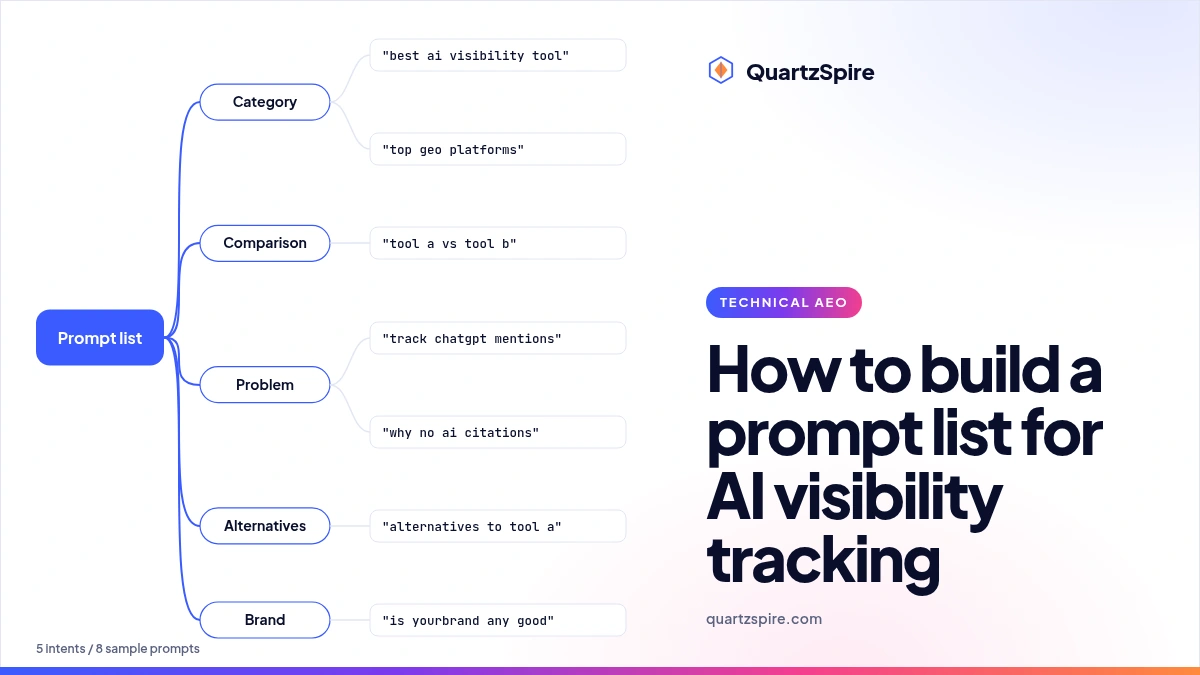
How to build a prompt list for AI visibility tracking
A prompt list is the denominator for every AI visibility rate. Here is a matrix you can copy, and the rules for adding or retiring a prompt.
On this page 10 sections
- What counts as one prompt
- Where the ten sentences come from
- A matrix you can paste
- Rules for adding a prompt
- Five gates before a prompt joins the list
- Rules for retiring a prompt
- How the list meets engines
- Handing the list to a tool
- Examples of prompts that fail the test
- Weak prompt vs fixed prompt
- A two-week build
- Ten working days to a frozen list
- FAQ
A prompt list is the set of frozen questions you will ask again, so that a change in the answer means something. It is the denominator for mention rate and citation rate. Without it, a dashboard is a tour of whatever the tool felt like showing.
Build the list before you buy a tracker, and keep the text in a file you own even after you buy one. AI visibility metrics divides by this list. How to track your brand is the weekly run. This page is only how the rows are born and how they die.
What counts as one prompt
One prompt is one exact string, one id, and a status: active or retired. The string includes punctuation. “Best payroll tool for a 40 person agency” and “Best payroll tool for a 40-person agency” are two prompts if both exist. Pick one and do not keep both unless you mean to track both.
The id is stable. P-01 never gets reused for a different sentence. If the sentence must change, P-01 is retired and P-11 is born. The history of P-01 stays in the log so old rates still have a definition. Deleting the row deletes the denominator of every chart that included it.
A prompt is not a keyword, not a title tag, and not a paragraph of instructions to the model. “You are a helpful assistant. Compare payroll tools.” is a system prompt. It contaminates the test. The string should be what a buyer would type and nothing else: no role play, no “be concise,” no request to cite you.
Where the ten sentences come from
Take them from places a person already asked. Sales call notes, support macros, the questions in lost-deal writeups, and the phrases in onboarding emails are enough. Reject anything nobody has said. A prompt you invented to sound strategic will measure your imagination.
Write the buyer’s words, including the constraint. “Payroll for a 40-person agency in California” is more useful than “payroll software” because the answer can be wrong in a way you can see. Short prompts are allowed when buyers are that short. Mark them as broad so you do not treat a vague answer as a failure of a specific page.
Group them as you collect, but do not let the group replace the sentence. The groups that earn their keep are stage and persona. Stage is the job of the question: learn a term, do a task, compare options, or check a price or limit. Persona is who is asking, in one or two words: founder, admin, buyer, developer. You do not need a novel. You need a filter.
A matrix you can paste
Copy this header into a sheet. One row is one prompt. Engines and locations are not extra prompts. They are columns you fill on each run, or a second table that pairs prompt id with engine and location.
id | status | stage | persona | prompt | page_url | added | retired | note
P-01 | active | learn | founder | What is answer engine optimization? | /guides/ai-visibility/what-is-aeo/ | 24 Nov 2026 | | definition
P-02 | active | do | admin | How do I export a subscriber list? | | 24 Nov 2026 | | missing page
P-03 | active | compare | buyer | How should a 15-person team track AI mentions without a tool? | /guides/ai-visibility/how-to-track-brand-mentions-in-ai-search/ | 24 Nov 2026 | |
P-04 | retired | price | buyer | How much does an AI visibility tool cost? | | 24 Nov 2026 | 1 Dec 2026 | replaced by P-11 after the wording changed
page_url can be empty. Empty means you do not yet have a page that should win. That is a backlog item, not a shame. Do not point P-02 at the homepage to fill the blank. What is AEO? is the standard for the page you will write: answer in the first two sentences.
The run table, separate from the prompt table, looks like this:
date | id | engine | location | signed_in | sources_shown | mention | cited_urls
24 Nov 2026 | P-01 | Perplexity | US | no | yes | 1 | https://example.com/aeo
Engine and location multiply the work. Ten prompts on two engines in one country is twenty rows a week. Ten prompts on four engines in three countries is 120 rows. If you will not paste 120 rows, do not plan 120 rows. What is AI visibility? tells you to pick two surfaces first. Obey that until the twenty-row week is boring.
Rules for adding a prompt
Five gates before a prompt joins the list
- A real buyer would type or say this sentence (source it: sales call, support ticket, or search console query)
- It does not contain your brand name
- One page on your site could answer it in two sentences, or you have logged that page as missing
- It is tagged with stage, persona, and owner
- It has an
addeddate, so rates before and after can be split
Add a prompt only when all of these are true. Someone heard the question from a real buyer, or it is a definition your site already intends to own. The string is frozen. An owner is named. You can say which URL should be cited, or you accept that the URL is missing. The weekly run still finishes if this row is included.
Adding a prompt because a tool suggested it is allowed only after a person rewrites it into buyer language and gives it an id. A suggested prompt you do not recognize is someone else’s denominator. Tracking it will not tell you about your pipeline.
Adding a prompt because you published a page is backwards but common. Prefer the other order: question, then page. If the page already exists, you may add the prompt that the page honestly answers. Do not write a prompt the page only tangentially mentions so the citation looks successful. You will teach the team to game the list.
When you add, do not recompute last month. Last month did not include this id. The series for the new id starts on the added date. AI visibility metrics is explicit: a changed list is a new series. The matrix makes that visible because added is a column.
Rules for retiring a prompt
Retire when the question is no longer asked, when the product no longer does the thing, or when the string was a duplicate. Set status to retired and fill the retired date. Leave the row. Runs before that date stay valid. Runs after that date should not happen. If a tool keeps firing retired prompts, that is a bug in the tool setup, not a reason to delete history.
Do not retire a prompt because the answers are unfavorable. That is how share of voice rises without a single page change. If the answers are wrong, the note column gets the correction plan. The id stays active until the question itself is dead.
If you must reword, retire and add. In the note, point from the old id to the new id: “replaced by P-11.” Someone reading a chart from October can still find the string that was live in October.
How the list meets engines
The same string goes to each engine. You are comparing surfaces, not rewriting the question until it flatters one product. How ChatGPT chooses sources, how to get mentioned in Perplexity, and how to appear in Google AI Overviews describe how those surfaces differ. The prompt table does not absorb those differences. The run table does, in the engine column and the sources_shown flag.
A prompt that is a full URL, or that names your brand and asks for a summary of your homepage, measures brand navigation. Keep a few if you care whether the model can find you by name. Do not let them dominate the list or citation rate will describe branded queries only. Mark stage as branded so you can filter them out of the category rate.
Handing the list to a tool
When the ten are stable, a tool may run them. The acceptance test is boring: the export contains your id, your exact string, the engine, the date, and the cited URLs. If the tool rewrites the string, it is running a different list. If it cannot store your id, you will not be able to join its export to your page_url column.
Best AI visibility tools and free AI visibility tools are the shelves. Best AI rank tracking software is the shelf if you are extending a rank tracker rather than starting from answers. Read prices on the vendor site. This page does not quote them. The SaaS cost-per-seat calculator is for the quote you receive. Count seats as people who will open the export.
If ChatGPT is the engine your buyers use most, start with the ChatGPT monitoring tools with prompt caps you can compare, and check that your ten strings fit inside the entry plan.
Keep a copy of the matrix outside the tool. If the contract ends, you still have the denominator. A login you cannot export is not a prompt list. It is a rental.
Examples of prompts that fail the test
Weak prompt vs fixed prompt
| Weak prompt | Why it fails | Fixed version |
|---|---|---|
| best tools | No category, buyer, or constraint | Which AI visibility tool fits a 5-person SEO team under $100 a month? |
| Is [Brand] good? | Branded, so every answer names you | Which tools track ChatGPT citations for a B2B SaaS site? |
| AI SEO tips 2026 | Topic, not a question a buyer asks | How do I get a pricing page cited in Perplexity? |
| Tell me everything about AEO | No single answer a page can own | What is answer engine optimization, in two sentences? |
| cheapest AI tracker?? | Ambiguous meter (prompts, credits, seats) | Which AI visibility tool has the lowest fixed monthly plan? |
A prompt fails when you would be embarrassed to run it in front of the person who owns the page. “Why is our product the best answer engine optimization platform for enterprises seeking synergy” fails because no buyer says synergy and the string begs for a compliment. “Write a 2,000 word essay on AI visibility” fails because it is a content order, not a question, and the answer will not cite a product page in a way you can compare next week. “site:example.com pricing” fails because it is a search operator, not an assistant prompt, and it measures a different product.
A prompt passes when a stranger can tell whether the answer was useful. “How do I export subscribers without emailing support?” passes if your product has that control. The page_url should be the help article that names the control. If the control does not exist, do not write the prompt as if it does. You would be training the log to record a lie. Leave the capability off the list until it ships.
Borderline prompts are comparisons that name you and a rival. They are allowed and they are branded. Mark them so they do not dominate share of voice. A list of ten where eight name your brand will produce flattering mention rates and teach you nothing about discovery. Keep two branded prompts if sales hears them. Fill the rest with the job to be done, without your name in the string. Then a mention means the answer introduced you. That is a different, and usually more interesting, event than an answer that repeated a name you supplied.
Write the bad examples into the note column when you reject them, in one line, so the next person does not revive them. “Rejected: keyword, not a question” is enough. The harvest folder will refill with the same keyword export next quarter. The note is how you refuse it faster.
Personas should change the constraint, not the adjective. “Admin” means the person has to live with the export. The prompt can mention the team size or the file they need. It should not say “as a world-class admin.” Role play makes answers longer and less comparable. If you need a persona, put it in the persona column and keep it out of the string. The column is for your filter. The string is for the engine.
Locations belong in the run table, but a prompt can include a place when the answer depends on it. “Payroll rules for a team in California” is a different question from “payroll rules.” If both matter, they are two ids. Do not rely on the location column alone if the words change the law or the product. The column records where you sat. The string records what you asked.
A two-week build
Ten working days to a frozen list
- Days 1 to 2: Pull 60 candidate questions from sales notes, support tickets, and search console.
- Day 3: Cut branded, duplicate, and topic-only rows. Target 20 to 50 survivors.
- Day 4: Tag each row with stage, persona, and the page that should win.
- Days 5 to 6: Run every prompt once on two engines and log raw answers.
- Day 7: Rewrite prompts that produced no comparable answer.
- Day 8: Freeze wording and assign IDs (P-01, P-02, …).
- Days 9 to 10: Load the list into your sheet or tool and run the first official baseline.
Days 1 and 2: harvest questions from ten real conversations. Days 3 and 4: cut to ten strings, assign ids, fill stage and persona, leave page_url blank where the page is missing. Days 5 to 9: run them once on two engines so you know the weekly cost in minutes. Days 10 to 14: assign the missing pages, or accept the blanks. Do not expand to thirty. Expansion is a reward for a finished week, not a kickoff activity.
How to get cited in ChatGPT uses the page_url column as the work list. If that column is empty, citation work has not started. The prompt list is still worth having. It tells you what you cannot yet answer in public.
Review the ten with one salesperson and one support lead. If they do not recognize a sentence, cut it, even if it matches a keyword report. The keyword can stay in the SEO report. It does not automatically earn a prompt id. That separation is GEO vs AEO vs SEO applied to a spreadsheet: two logs, two units, no blended score.
Keep each prompt the length a buyer would type: the word counter and the character counter make a prompt that has grown into a paragraph easy to spot.
FAQ
Should prompts look like keywords?
No. A prompt is a question or a request a person would type into an answer engine. A one-word keyword is a different test. Keep keywords in your search report.
How many prompts do we need?
Ten that you run every week. Add more only when the weekly run is still finishing. The metrics page divides by this list, so a list you cannot finish makes every rate late.
Can we use the same prompt on every engine?
Yes. The string stays the same. The engine is a column, not a rewrite. If an engine needs a shorter question, that shorter question gets a new id.
Who is allowed to change a prompt?
One owner. Everyone else proposes a new id. Silent edits are how a chart moves without a page change.
Where do tools fit?
After the ten exist. Best AI visibility tools and the prompt-related roundups are shopping pages. A tool should store your exact string, not replace it with a generated variant.
See a factual problem? Write to hello@quartzspire.com with this page URL.