 Profound Custom quote
 Peec AI $95/mo
 Otterly.AI EUR 29/mo
 Scrunch $250/mo
 AthenaHQ $295/mo
 Semrush AI Toolkit $99/mo
 Ahrefs Brand Radar $50/mo
 SE Ranking $129/mo
 Rankscale EUR 99/mo
 Promptwatch $95/mo
 Goodie $295/mo
 Evertune $60/mo
AI Visibility
How to appear in Google AI Overviews
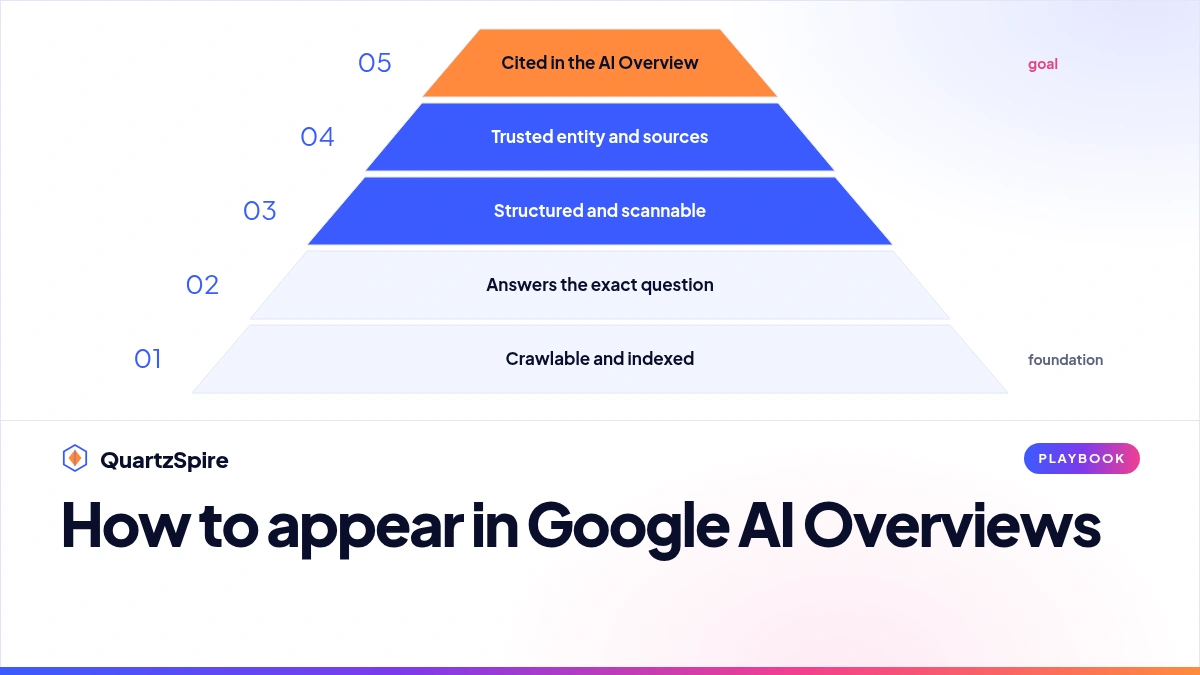
AI Overviews are part of Google Search. You cannot opt a query into one. You can make a page worth citing and check whether an overview used it.
On this page 9 sections
- Treat the overview as a maybe, not as a layout
- Log the overview and the classic result separately
- Overview log row template
- Write the page the overview would be right to use
- Study the links the overview already chose
- Rerun on a schedule, not after every title tweak
- Tools, prices, and the hours they replace
- How to choose the queries worth checking
- Query triage for overview tracking
- When a query should leave the weekly list
- A month that respects the feature
- Four-week overview plan
- FAQ
You appear in a Google AI Overview when Google chooses to show an overview on that query and includes your URL among the sources. You cannot file a query for overview eligibility, and you cannot see a score for “overview rank.” You can check the query, record what showed, and improve the page you wish had been the source.
Google has described AI Overviews as a Search feature that uses its ranking and content systems, and that can link out to supporting pages. The product details change. The operating rule does not: look at the query in the country you care about, and write down what is on the screen.
Treat the overview as a maybe, not as a layout
Some queries show an overview. Some do not. Some show one in one country and not in another. Some show one to a signed-in user and a different block to a signed-out user. If your report assumes every target query has an overview, the report is wrong on the days it does not.
Add a column: overview present, yes or no. A “no” is not a failure of your page. It is the feature being absent. Only the “yes” rows can have a citation miss. What is AI visibility? makes the same point for other answer boxes. Do not mix “feature off” with “feature on and we were skipped.”
Run the check signed out, in the country you sell in, unless you are deliberately testing another condition. Label the condition. A VPN and a personal account will not match, and they should not be averaged.
Log the overview and the classic result separately
Overview log row template
| Date | Query | Overview shown | Our URL cited | Cited URLs | Classic rank |
|---|---|---|---|---|---|
| 24 Nov 2026 | how to track brand mentions in ai search | yes | yes | 4 URLs logged | 6 |
| 24 Nov 2026 | ai visibility tool pricing | no | n/a | n/a | 9 |
“Overview shown: no” is not a lost citation. Keep it out of the citation-rate denominator.
Open the query. If an overview is there, list every linked source you can see. Then list the first classic organic result, if you are still tracking it. They will not always match. That mismatch is the reason this page exists.
| What you record | Why | What you skip |
|---|---|---|
| Query, country, date, signed-in or not | Conditions change the screen | A screenshot with no note of country |
| Overview: yes or no | Absence is its own state | A blank that might mean either |
| URLs linked from the overview | Those are the citations you can discuss | A guess based on who ranks |
| First classic organic URL | The SEO outcome, kept separate | Copying it into the overview column |
| Whether your domain is in either list | The weekly count | A blended “visibility score” |
GEO vs AEO vs SEO is the vocabulary if someone wants to call this GEO. The columns do not change when the label changes. How to track brand mentions is the full sheet. Use it. A one-off Search Console export will not contain the overview’s linked URLs as a neat query report you can assume is complete. If you are not sure a report includes overview links, do not pretend it does. Look at the page.
Write the page the overview would be right to use
The page should answer the query in the first two sentences, in the same words a searcher uses. Then give the conditions and the steps. If the query is a comparison, use a table with a column for the difference, not a list of brand adjectives. If the query is a definition, define it and say what it is not, as this site does for AEO.
Pages that expire need a date in the sentence: prices, limits, laws, product steps. AI visibility tool pricing is the commercial cousin of that rule. An overview that quotes an undated price is often quoting you. Fix the page before you blame the summary.
Do not create a second URL that repeats the same answer in “AI language.” One canonical page should win. Duplicates split whatever retrieval you earned and confuse the classic result as well. This is ordinary SEO, and it still applies. Schema markup for AI search belongs on that one URL, matching the visible text, not on a doorway.
Study the links the overview already chose
When your URL is missing, open the ones that are present. Note the type: docs, a publisher, a video, a forum, a product page. If Google is citing docs and you sent a thought-leadership essay, write the doc. If it is citing a publisher, your next move may be a correction or a source for that publisher, not another essay.
How to get cited in ChatGPT uses the same “read the winner” step. The engines differ. The discipline does not. How Perplexity mentions brands is the third copy of the discipline, for people who asked about that product. Do not merge the three logs. A win on an overview is not a win in Perplexity.
If the cited page is wrong about you, collect the primary source and send it. A public correction beats a private complaint. If the cited page is right and you simply were not the best source, say that in the meeting. It saves a rewrite that will not change the overview.
Rerun on a schedule, not after every title tweak
Pick a day. Check the query set the same way. Store overview present, the linked URLs, and the classic URL. Change a page only when the same miss repeats. Title tweaks every afternoon make the log unreadable, because you no longer know which version was fetched.
Give a changed page time to be recrawled before you declare the test failed. You do not control that interval. What you control is not declaring victory from one signed-in refresh.
AI visibility metrics can express “share of overview citations” only as cited queries divided by queries that showed an overview. Dividing by all queries treats a missing feature as a loss. Do not do that. The metrics page should be read with that warning in mind. If a dashboard does the wrong division, export the rows and divide them yourself.
Tools, prices, and the hours they replace
Hand checks work for a short list in one country. A tool earns its place when you have many queries, more than one country, and a need to keep the raw screen. AI Overview tracking tools is the roundup for that shopping. Best AI rank tracking software covers products that grew out of rank tracking and added answer features. Read both as catalogs. The price you put in a budget is the price on the vendor site, or “custom quote” if they will not publish one.
The software ROI calculator is for the hours the tool replaces: someone refreshing queries and pasting URLs. Type those hours and the yearly cost. Do not type a guessed lift in organic clicks. Overview research is still early, and this page will not invent a click-through rate for you.
Best AI visibility tools is the wider set if the overview log is only one engine among several. Buy the narrower tool if overviews are the only gap. Extra engines you will not read are a seat you will not use.
How to choose the queries worth checking
Query triage for overview tracking
| Query type | Overview likely? | Worth tracking? | Why |
|---|---|---|---|
| How-to and definitions | Often | Yes | Overviews tend to summarize steps and definitions |
| Comparison (X vs Y) | Sometimes | Yes | Cited sources are often comparison pages |
| Branded navigational | Rarely | No | Users want the homepage |
| Local with map intent | Varies | Only with a local plan | Map pack competes for the slot |
| Breaking news | Varies | No | Volatile and time-bound |
Verify each row on your own queries; this is a triage guide, not a measured rate.
Start from queries that already have a job in the business: they bring signups, they appear in sales calls, or they are the definitions your category argues about. Do not start from a scraped list of every phrase that includes the product. Overview checks are manual until a tool earns trust, and a long list will be abandoned. Twenty queries you open every week beat two hundred you open once.
Drop queries that are navigational to someone else’s brand unless you have a real comparison page. An overview on a rival’s brand name will often cite the rival. Logging that every week teaches you nothing new. Drop queries you cannot answer in public. If the true answer is “it depends, book a call,” you do not have a page an overview should use, and you should not publish a fake certainty to chase the link.
Group the twenty by intent: definition, how-to, comparison, pricing, troubleshooting. You will see which intents actually trigger an overview in your country. That observation is allowed. A universal claim about “informational queries always get overviews” is not, because you did not check the world’s queries. Say what you saw in your twenty. AI visibility prompts uses the same restraint when the list grows. Add a query only when it has a page, or a page is assigned. An unassigned query is a wish.
Write the owner next to each query. Definitions might sit with a writer. Troubleshooting might sit with support. Pricing queries sit with whoever is allowed to state a number, and the number needs a date. If no one owns the query, take it off the list. Ownerless queries are how the log fills with blanks and then gets ignored. A blank week should be a miss by the owner, visible in the meeting, not a quiet hole.
When a query should leave the weekly list
When a query never shows an overview across four weeks, move it to a quarterly check instead of the weekly list. You still care about the classic ranking. You do not need to pretend an overview is late. Say the feature did not show. Put the weekly attention on queries where an overview does show and the linked URL is wrong. That is the only place a rewrite can change the thing this page is about.
Review the list monthly with sales. If they have not heard a query in a month, demote it. If they have heard a new one twice, add it with a page assignment and a start date so it does not contaminate the old rates. AI visibility metrics depends on this hygiene. A dirty query list makes a dirty rate, and the rate will be the number someone puts on a slide.
A month that respects the feature
Four-week overview plan
- 01Week 1Log 20 queries for overview presence and cited URLs
- 02Week 2Rewrite openings on the 3 pages closest to being cited
- 03Week 3Do not touch titles; rerun on the same weekday
- 04Week 4Report presence rate and citation rate separately
Week one: twenty queries that already matter in search, each with country. Week two: check each one signed out and fill the table, including overview yes or no. Week three: rewrite the three pages that lost repeatedly to a clearer source, answer first. Week four: check again. Report how many queries showed an overview at all, and on how many of those your URL was linked. That fraction has a denominator you can defend.
Skip the project that adds “2026” and “AI” to every title. Skip the project that blocks Google’s crawler to “test what happens.” You already know a blocked page is a poor source. robots.txt for AI crawlers is for deliberate policy, not for a stunt.
If the month shows overviews on two queries out of twenty, say that. The feature is uneven. A strategy that assumes a box on every keyword will hire and spend as if the box were guaranteed. It is not.
Write the fraction in words as well as digits so nobody drops the denominator. “An overview appeared on 2 of 20 queries, and our URL was linked on 1 of those 2” is a complete sentence. “We rank in AI Overviews” is not. If your count is zero overviews, the sentence is “no overview appeared on these 20 queries in this country this month.” That sentence should end the overview project for the month and send the team back to the classic page, which still has a job. Do not invent a plan to “trigger” overviews. You do not have that control. You have queries, pages, and a log.
Keep the screenshots in a folder named by query id and date if someone demands proof. The sheet is still the record. Screenshots without the yes-or-no column get selected for the pretty ones. The pretty ones are usually the queries where you already looked good. The sheet forces the other queries to stay in the meeting. That is the only reason the column exists. Use it even when the news is dull. Dull news is how you avoid hiring for a feature your buyers are not being shown.
To turn a count into a rate, run it through the percentage calculator.
FAQ
Can we turn on AI Overviews for our keywords?
No. Google decides which queries show an overview. Your work is the page and the sources around it. Check the query in the country you sell in, and record whether an overview was there.
If we rank first, will the overview cite us?
Not necessarily. Open the query and read the links inside the overview. Log them next to the classic result. Do not copy the classic rank into the overview column.
Should we write shorter pages to be included?
Write the answer in the first sentences, then keep the proof. A short page that omits the condition will be quoted wrongly. A long page that hides the answer will be skipped for one that states it.
Do AI Overviews replace the need for SEO?
No. The overview is still Google Search. Fetchable pages, clear queries, and useful links remain the job. Add a column for whether an overview appeared and which URLs it showed.
Which tool tracks overviews?
Any log you trust, including a spreadsheet, if the volume is small. The AI Overview tracking roundup compares products. Confirm the price on the vendor's site and ignore undated figures.
See a factual problem? Write to hello@quartzspire.com with this page URL.