 Profound Custom quote
 Peec AI $95/mo
 Otterly.AI EUR 29/mo
 Scrunch $250/mo
 AthenaHQ $295/mo
 Semrush AI Toolkit $99/mo
 Ahrefs Brand Radar $50/mo
 SE Ranking $129/mo
 Rankscale EUR 99/mo
 Promptwatch $95/mo
 Goodie $295/mo
 Evertune $60/mo
AI Visibility
Schema markup for AI search: what actually matters
Schema helps a parser read a page. It does not force a citation. Use JSON-LD that matches the visible text.
On this page 9 sections
- What to mark up, and what to leave alone
- A guide graph you can copy
- FAQPage only when the questions are on the page
- How this relates to being cited
- Validate, then look at the page
- What a listicle should and should not mark up
- Listicle ItemList without ratings
- Fields that quietly go wrong
- Schema fields that drift
- A small rollout
- Schema rollout in four steps
- FAQ
Schema markup is structured data, usually JSON-LD, that states the type of a page and a few facts about it in a form a parser can read without guessing from layout. For AI search, the part that matters is narrow: the facts in the markup are the same facts a person sees, the type is one you can defend, and you do not pretend the markup buys a citation.
Answer engines retrieve pages and may cite them. They are not a schema contest. How ChatGPT chooses sources does not include a JSON type as a published weight. Use markup to be unambiguous. Use the prompt log to see if you were cited. Those are different jobs.
What to mark up, and what to leave alone
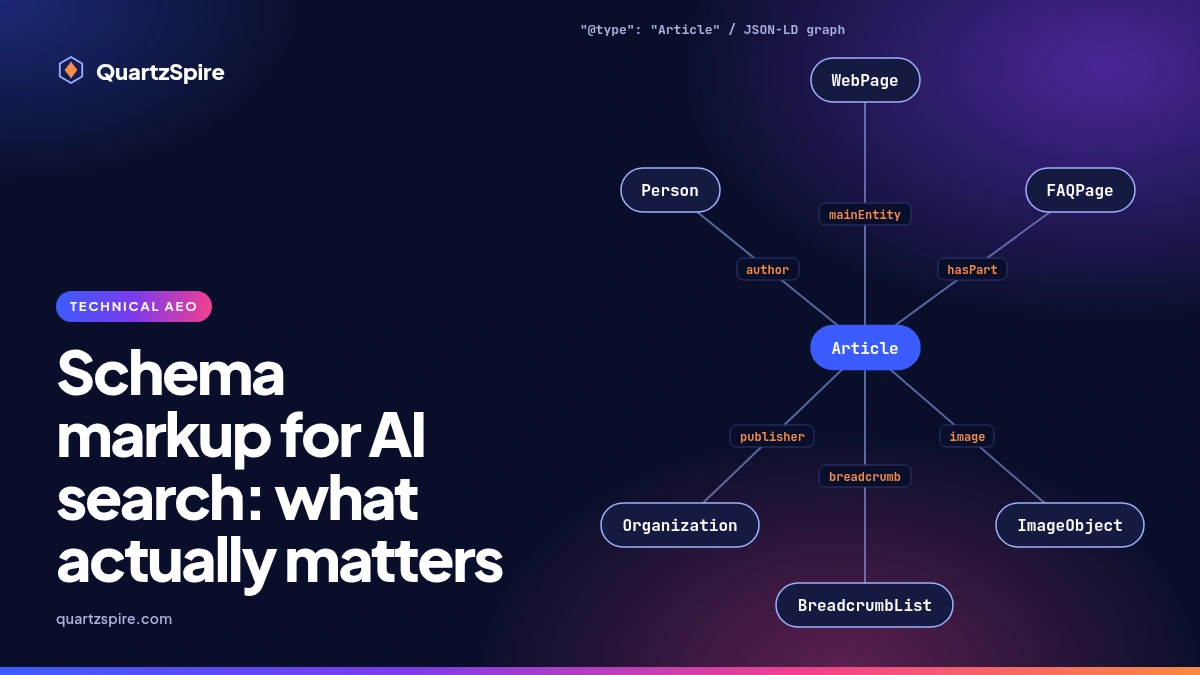
Mark up what the template already shows. A guide has a title, a description, dates, an author, and a URL. That is an Article, or a BlogPosting if you prefer that subtype and your dates are real. A visible list of questions and answers is an FAQPage. A visible trail of links is a BreadcrumbList. The site itself is an Organization. A real author is a Person.
Leave alone anything you cannot see on the page. A rating you did not collect, a review you did not receive, a price that is not printed, and a video that is not embedded are not candidates. aggregate rating markup for a third-party star count is the usual mistake. The stars belong to another site. Putting them in your JSON claims a review graph you do not have. QuartzSpire’s listicle template can show a rating in the text when a source and a count exist, and it does not emit aggregate rating markup. Keep that split.
Leave alone a second, hidden FAQ that exists only in the script tag. If the questions are worth asking, print them. What is AEO? wants the answer in the first sentences of the HTML. Schema does not replace that sentence.
A guide graph you can copy
This is the shape, not a claim that every field is mandatory. Replace the placeholders. Keep the author as a person with a URL on your own site. Do not add sameAs unless the profile is real and you are willing to maintain it. This site’s author page has no sameAs.
{
  "@context": "https://schema.org",
  "@graph": [
    {
      "@type": "Article",
      "headline": "Schema markup for AI search: what actually matters",
      "description": "Schema helps a parser read a page. It does not force a citation.",
      "datePublished": "24 Nov 2026",
      "dateModified": "24 Nov 2026",
      "author": {
        "@type": "Person",
        "name": "Md Shihab Mia",
        "url": "https://quartzspire.com/authors/md-shihab-mia/",
        "jobTitle": "Writer"
      },
      "publisher": {
        "@type": "Organization",
        "name": "QuartzSpire Editorial Team",
        "url": "https://quartzspire.com/"
      },
      "mainEntityOfPage": "https://quartzspire.com/guides/ai-visibility/schema-markup-for-ai-search/"
    }
  ]
}
jobTitle is Writer. Do not write Founder unless that is the role. The publisher is the editorial team, not the writer. The author page is the URL in the person node. If the name in the byline and the name in the JSON differ, fix one of them before you ship.
Dates are ISO dates you mean. Do not stamp dateModified with the build time on every deploy. A modified date that changes when nobody edited the article teaches parsers, and readers, to ignore it. This site’s sitemap uses the date in the file for the same reason.
FAQPage only when the questions are on the page
If the template prints the questions, mirror them. The text in the JSON should be the text on the screen, not a longer answer you hid. Parsers and readers should not disagree.
{
  "@type": "FAQPage",
  "mainEntity": [
    {
      "@type": "Question",
      "name": "Will FAQ schema get us into AI answers?",
      "acceptedAnswer": {
        "@type": "Answer",
        "text": "No. It can make questions and answers explicit. An engine can ignore it."
      }
    }
  ]
}
Four to six real questions are enough. A block of twenty questions written for a keyword list is a bad page and a bad FAQPage. How to build a prompt list is about questions buyers ask. FAQ entries should be able to survive that test. If a buyer would not ask it, do not mark it up.
Breadcrumbs are the short trail. Each item needs a name and, except sometimes the current page, a URL. The URLs should be the canonicals, including the trailing slash this site uses. A breadcrumb that points at a redirect is a small lie. Fix the link.
How this relates to being cited
A clear Article node can help a system know the headline and the date. It cannot make a thin page a good source. The passage that answers the question still has to be in the HTML. How to get cited in ChatGPT spends its time on that passage. Schema is a checklist at the end, not the method.
The same rule holds for Google: the guide on how to appear in Google AI Overviews starts with the passage, not the markup.
If you are tempted to add a type because a thread said “AI loves HowTo,” read the page. If you do not have steps, do not emit HowTo. Empty steps are invalid in spirit even when a validator is sleepy. Speakable and other optional types are the same: use them when the text exists, otherwise omit them. Omission is cleaner than fiction.
llms.txt explained is a different file with a different job. Do not generate llms.txt from schema, or schema from llms.txt, unless both are generated from the same source of truth. Two hand-maintained copies will diverge. The page is the source of truth. The JSON and the Markdown map should follow it.
Validate, then look at the page
Run a JSON validator so quotes and commas are intact. Then open the page and check four things. The headline matches the H1. The dates match the byline. The author name matches the visible byline and the author URL returns that person. The FAQ questions match the visible questions in order, or at least in wording.
Check that you did not emit aggregate rating markup. Search the HTML for that type before a release if the template changed. A regression here is quiet and embarrassing, because the stars look official.
Check the canonical. mainEntityOfPage should be the canonical URL, not a parameterized duplicate and not the http version. GEO vs AEO vs SEO is a reminder that classic SEO rules still apply. Structured data on the wrong URL is structured data for a URL you do not want.
What a listicle should and should not mark up
Listicle ItemList without ratings
{
  "@context": "https://schema.org",
  "@type": "ItemList",
  "name": "12 Best AI Visibility Tools in 2026, Compared",
  "itemListOrder": "https://schema.org/ItemListOrderAscending",
  "itemListElement": [
    { "@type": "ListItem", "position": 1, "name": "Profound", "url": "https://quartzspire.com/guides/ai-visibility/best-ai-visibility-tools/#item-profound" },
    { "@type": "ListItem", "position": 2, "name": "Peec AI", "url": "https://quartzspire.com/guides/ai-visibility/best-ai-visibility-tools/#item-peec-ai" }
  ]
}
A listicle is an Article plus an ItemList of the products, plus FAQPage if the questions are visible. The ItemList names and positions should match the ranks on the page. Do not mark a paid row as an award. The visible label says Featured. The JSON does not need a special advertising type for the row if the HTML already says the word. It must not describe the row as an independent review score.
Ratings, if you show them, stay in the HTML with the source, the count, and the month. They stay out of aggregate rating markup. Best AI visibility tools and best AEO tools are the commercial pages that will follow that rule when they are published. This guide is the constraint they have to satisfy.
Prices in JSON are optional and dangerous if they drift. If you do not have a checked price, omit Offer. “Custom quote” in a sentence is more honest than a fabricated price in a structured field. AI visibility tool pricing is where checked prices will live, with a date. Until a price is checked, it is not in the graph.
Fields that quietly go wrong
Schema fields that drift
| Field | How it goes wrong | Rule |
|---|---|---|
| dateModified | Updated on every deploy | Change only when content changes |
| author | Generic “Admin” | Real byline: Md Shihab Mia, Writer |
| aggregateRating | Copies a G2 score | Never mark up third-party ratings |
| FAQPage | Questions not visible on page | Mark up only visible Q and A |
| image | Points to a missing file | Use a live 1200x630 asset |
headline must be the H1, not the title tag if the title tag adds the site name. If the title tag is “Schema markup for AI search: what actually matters · QuartzSpire” and the H1 omits the site name, the JSON headline should follow the H1. Duplicating the branded title inside headline makes a parser repeat the brand. The site name belongs on the publisher or the WebSite node.
description in JSON should be the meta description or the lede, and it should be a sentence you would say. Do not stuff it with a list of engines. datePublished is the first publication. dateModified is the last real edit. If you fix a typo, you may bump dateModified. If the build rewrites the file every night with no human change, do not bump it. Authors who see a page “updated” every day stop trusting the line. So do readers.
image, if you include it, must be a URL that returns the image. A 1200 by 630 Open Graph image is a reasonable choice when that file exists for the page. Do not point image at a logo and also claim it is a photograph of the article. The author image is optional. This site uses initials on the author page and does not invent a headshot in JSON. Omit image on the person if you do not have one. An empty string is invalid. Absence is valid.
inLanguage, if you set it, should match the page. en-US is fine for these guides. Do not mark a page as reviewedBy a person who did not review it. reviewedBy is a claim. The byline is already a claim. One real person is enough.
URL fields must be absolute. A relative /guides/… path inside JSON-LD resolves unpredictably for a parser that does not share your origin assumptions. Use the canonical host. Match trailing slashes to the canonical. A breadcrumb item that omits the slash and a canonical that includes it are two URLs. Pick the canonical form and use it everywhere in the graph.
If you embed the graph in a script tag, escape characters that would close the tag. A less-than in an answer string can break the HTML. The page can look fine and the JSON can be truncated. A validator on the built HTML, not only on the source template, is the check that catches it. Run it on a guide that contains a code sample, because code samples are where raw characters hide. This page is one of those guides. If its own JSON fails after a template change, the template is not ready for the other thirteen.
A small rollout
Schema rollout in four steps
- Ship Article plus BreadcrumbList on one guide template.
- Validate with the Rich Results Test and Schema Markup Validator; fix every error.
- Add FAQPage only where the questions are visible on the page.
- Re-validate after each deploy and spot-check that visible facts match the JSON-LD.
Week one: confirm Article, breadcrumbs, and FAQ on one guide, and confirm the HTML matches. Week two: stop emitting any type you cannot see, especially ratings. Week three: add the same pattern to the template so writers do not hand-write JSON. Week four: search the built HTML for aggregate rating markup and for sameAs you did not intend. Then leave it alone.
Do not spend the month on a schema vendor. The software ROI calculator will tell you the yearly cost of a seat against hours. The hours to keep JSON honest are low if the template generates it. They are high if every author pastes a block. Generate it. Best AI rank tracking software will not fix a mismatched FAQ. A template will. Large sites that need schema audits across many templates can review enterprise AI visibility platforms, several of which bundle site monitoring with answer tracking.
How to measure traffic from ChatGPT in GA4 is unrelated to schema and easy to confuse in a roadmap. Schema does not create the referrer. Do not put both projects in one ticket. One ticket, one file: the template that prints JSON, or the channel group that reads referrers.
After the template change ships, view the source of one guide and one listicle. Search for “@type”. You should see Article, FAQPage, BreadcrumbList, and the site Organization. You should not see aggregate rating markup. You should see the author URL with a trailing slash. You should see jobTitle Writer. If a listicle has no reviews, you should not see a rating node invented to satisfy a rich-result gallery. Empty nodes are how fake stars start. The gallery can live without them. The page is more credible without them. Repeat the search after the next template edit, not after every article. The template is the risk. Individual articles that only change prose do not change the graph if the graph is generated. That is the argument for generation. Hand-written blocks drift, and drift is how a founder title or a sameAs link appears months later because someone pasted an old example. The example on this page is the one to paste, and it has neither.
Paste the JSON-LD into the JSON formatter to catch a missing brace before you validate it.
FAQ
Will FAQ schema get us into AI answers?
No. It can make questions and answers explicit. An engine can ignore it. Put the same questions in visible HTML. The FAQPage node is a mirror, not a second article.
Should we mark up star ratings from G2 or Capterra?
Not as aggregate rating markup on your page. Those are someone else's reviews. QuartzSpire does not emit aggregate rating markup for third-party scores. Show the source in the sentence if you mention a rating at all.
Is JSON-LD better than microdata?
JSON-LD in a script tag is easier to keep next to a template without scattering attributes through the HTML. Either can be valid. Pick one and match the visible text.
Do answer engines require schema?
No published answer engine requires a specific type before it will cite a page. Pages without schema are cited every day. Do not block a launch on a perfect graph.
Where should Organization markup live?
Once, on the site, with the name, URL, and logo you actually use. Do not invent a sameAs profile. A person node for an author should name a real person and link to their page on your site.
See a factual problem? Write to hello@quartzspire.com with this page URL.