 Profound Custom quote
 Peec AI $95/mo
 Otterly.AI EUR 29/mo
 Scrunch $250/mo
 AthenaHQ $295/mo
 Semrush AI Toolkit $99/mo
 Ahrefs Brand Radar $50/mo
 SE Ranking $129/mo
 Rankscale EUR 99/mo
 Promptwatch $95/mo
 Goodie $295/mo
 Evertune $60/mo
AI Visibility
How ChatGPT chooses which websites to cite
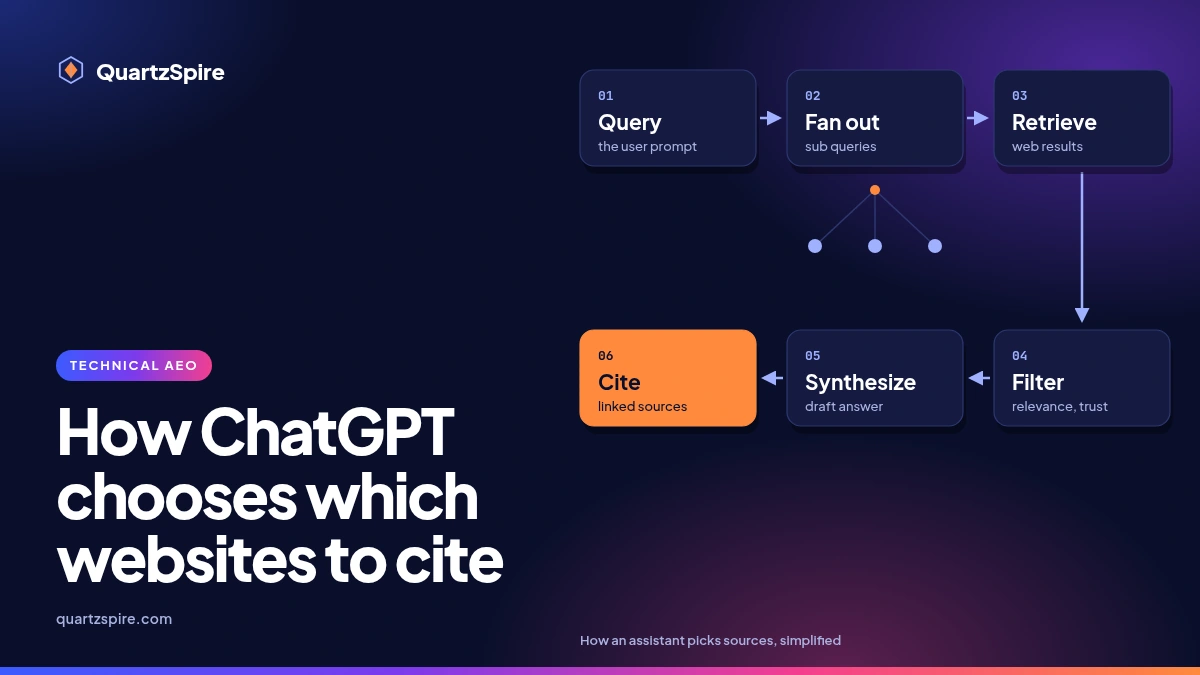
ChatGPT can cite pages it retrieved while answering. The ranking formula is not public. Here is what you can see, and what you should not invent.
On this page 10 sections
- Search-backed answers are not every answer
- What is public, and what is not
- How to read a citation you did get
- How to read a citation you did not get
- Conditions that move the answer without you changing a page
- What changes a citation without touching your page
- What on-page changes are reasonable
- A small test you can finish this week
- Five-day citation test
- A field note you can repeat without a theory
- Field-note template
- What to say in the next meeting
- FAQ
When ChatGPT shows sources, it is pointing at pages it used, or retrieved, for that answer. The product decides whether to search, which pages to keep, and which of those to show. OpenAI describes search and browsing features in its own help docs. It does not publish a formula you can tune like a bid.
So the honest version is short. You can see the citations on the answers that have them. You can change your pages and other sources. You cannot see the score, and you should not invent one.
Search-backed answers are not every answer
ChatGPT is a chat product that sometimes retrieves from the web. A reply that answers from the model alone may name a brand from training data and show no source. A reply that uses search can attach citations. If you mix those two modes in one spreadsheet, you will call “no citation” a failure on answers that never looked anything up.
Write the mode in the log: the product name, whether search or browsing was available, and whether sources were on screen. How to track brand mentions in AI search uses that column so a week of “no link” is not confused with a week of “did not search.”
Signed-in state, memory, custom instructions, and prior turns change the reply. For a measurement, start a fresh chat, skip the biography, and paste only the prompt. If you need to see what a logged-in customer sees, that is a second test with a second label. Do not average it with the fresh chat.
What is public, and what is not
Public material tells you that search can retrieve pages and that the interface can display them. It does not tell you the weight of domain age, of a particular schema type, of a backlink, or of a sentence length. If a guide gives you those weights, it is not quoting OpenAI. It is guessing. QuartzSpire will not guess with you.
What you can learn from the screen:
| What you see | What it supports | What it does not support |
|---|---|---|
| A source card with a URL | That URL was shown for this prompt, in this session, on this date | That it will be shown tomorrow, or that it was the only candidate |
| The brand name in the paragraph | A mention, which you can count | A citation, unless a source points at you |
| No sources at all | This reply did not show any | That your page was rejected. The reply may not have searched |
| A rival’s docs as the only source | A concrete page to study | A permanent loss. Retrieval sets change |
What is AI visibility? uses the same split between mention and citation. Keep it. Teams that tick a single box cannot tell a naming problem from a sourcing problem.
How to read a citation you did get
Open the URL. Check that it still says what the answer said. Answers can attach a source that only partly supports the sentence. If your page was cited for a claim you do not make, fix the page or the surrounding passage so the next retrieval has less room to stretch. If a publisher was cited and the line is wrong, send them the correction with the primary source. Do not argue with the chat and then count the argument as a new data point.
Note the path, not only the domain. A citation to your homepage is a different event from a citation to the article that answers the question. Homepages are vague. If the engine keeps citing the homepage, the specific page may be hard to fetch, hard to summarize, or absent. Give the question its own URL. What is AEO? is the production habit: one question, one page, answer first.
Look at the date on the cited page if it has one. An undated page that describes a price or a limit will be quoted after it is wrong. Put the check date in the sentence. AI visibility tool pricing is the commercial version of that rule. This mechanics page has no vendor prices on purpose.
How to read a citation you did not get
List the URLs that were shown. Read them. Ask which sentence they had that yours lacked. Often the winner states the answer in one or two sentences and then shows a table or a list. Often it is a third-party page a buyer already trusts. Sometimes it is simply the page that was fetched, and yours timed out.
You do not get the rejected set. Do not invent a story about “the algorithm hated our H1.” You can test a change: revise the page, wait until it can be fetched again, and rerun the same prompt in a fresh chat on several days. If the citation never moves, the retrieved set may not include you, or the answer may be drawing on a source you cannot out-write. Both are possible. The log tells you how often. It does not tell you the weight.
How to get your brand cited in ChatGPT is the work list after this diagnosis. Read this page first so the work list is not a pile of tactics aimed at a formula you have not seen.
Conditions that move the answer without you changing a page
What changes a citation without touching your page
| Condition | Effect on sources | How to control for it in a test |
|---|---|---|
| Search on or off for that answer | No search usually means no citations | Log whether sources were shown |
| Signed-in vs logged-out session | Different defaults and history | Use one account state for every run |
| Location and language | Different retrieved pages | Fix one location per series |
| Prompt wording | Different query fan-out | Use frozen prompt IDs |
| Date | Fresh pages enter, old ones drop | Rerun on a fixed weekday |
Location, language, and time change retrieval. A prompt run in one country is not evidence about another. Label the test. Repeating the prompt in the same chat contaminates it, because the model can see what it just said. New chat, same prompt, written conditions. That is the whole experimental design. It is slower than a dashboard and it is auditable.
A tool that runs the prompt for you is doing this loop in bulk. It is valuable when it stores the raw answer and the URLs. It is not valuable when it stores only a score. ChatGPT brand monitoring tools is the roundup for products aimed at this engine. AI citation tracking tools is the roundup aimed at the citation event across engines. Prices belong on those pages only after a check against the vendor, with the date in the note. This page does not quote them.
Personalization is a feature for the user and a nuisance for the analyst. If your executives all have memory turned on, their screenshots will not match the fresh-chat log. Show them both, labeled. Do not pick the flattering one.
What on-page changes are reasonable
Reasonable: a direct answer, a stable URL, fetchable HTML, a visible date on facts that expire, internal links to the next question, and markup that matches visible text. Schema markup for AI search lists the types that match that standard. Unreasonable: hidden text, fake reviews, a claim that schema “forces” ChatGPT, or a paragraph written only for a crawler.
Robots policy is reasonable when it is deliberate. robots.txt for AI crawlers separates a bot that fetches for a user-facing answer from other agents. Blocking the bot that fetches sources can reduce future citations from that bot. It will not delete a citation pattern that came from pages already known. Allowing every agent because a thread said so is not a strategy either.
llms.txt is optional and unproven as a citation lever. What is llms.txt? says what the file is. Do not expect this choice mechanism to read it just because you uploaded it. If you publish it, do it as a courtesy map of your best URLs, and keep those URLs good.
A small test you can finish this week
Five-day citation test
- Day 1: Pick 10 non-branded prompts and log baseline answers with sources shown.
- Day 2: Confirm OAI-SearchBot is not blocked in robots.txt for the target pages.
- Day 3: Rewrite the first two sentences of one target page to answer one prompt directly.
- Day 4: Request recrawl or wait; do not change other pages.
- Day 5: Rerun the same 10 prompts in the same account state and compare cited URLs.
Choose five prompts a buyer would ask, each specific enough to deserve a page. Run each in a fresh ChatGPT session with search available, once a day for five weekdays. Store the cited URLs. On Friday, open every cited URL and write one line: “answers the question” or “does not.” If your URL is absent, write what the cited page did in its first two sentences.
That packet is your evidence. Take it to the writer who owns the closest page. Do not take a theory about token weights. The prompt list guide helps you expand the five later without diluting them. The metrics guide helps you turn the five into a rate once the denominator is stable.
If someone wants a tool in the same week, the software ROI calculator will compare a yearly cost with hours saved, using numbers you type. Hours saved means the logging you will stop doing by hand. It does not mean “citations we hope to gain.” Hope is not an input the calculator accepts, because you would have to type it as if it were a fact.
A field note you can repeat without a theory
Field-note template
Date:        24 Nov 2026
Prompt ID:   P-07
Engine:      ChatGPT (search shown: yes)
Account:     logged out, US English
Named us:    no
Cited URLs:  vendor-docs.example/pricing ; review-site.example/list
Our URL:     none
Next action: add a two-sentence answer to /pricing-guide/ and rerun 1 Dec 2026
After each fresh run, fill four lines and stop. Line one: prompt id, date, country, and whether sources were on screen. Line two: every URL in the source list, pasted, not retyped from memory. Line three: brands named in the answer, including yours, marked with the exact string. Line four: one sentence on whether the cited pages actually support the answer. That note is more useful than a paragraph about embeddings. It takes ten minutes. It does not require a belief about how the chooser works.
At the end of five runs, sort the URLs by how often they appeared. The list is your observed retrieved set for that prompt, not the full candidate set. Say that out loud when you present it. People will want to treat the top URL as “what ChatGPT prefers” in general. It is what this prompt showed on these five days. The next prompt can prefer a different kind of page. AI visibility prompts is how you add a prompt without pretending the first list was universal.
If the same third-party URL appears in all five runs, read it with a writer. Copy nothing. Note the first sentence, the presence or absence of a date, and whether a table carries the comparison. Those are attributes you can change on your own URL. “Authority” is not an attribute you can edit this afternoon. Leave it out of the field note. If your URL appears once, mark it as unstable. Unstable citations are a reason to keep running the prompt, not a reason to announce a win in the company channel.
When the field notes disagree with a vendor chart, trust the notes until the vendor can show the same chats. Charts that cannot be opened are opinions with axes. ChatGPT brand monitoring tools should be judged by whether they reproduce the field note, including the raw URLs. A product that only gives you a trend line has not replaced the note. It has hidden it. Keep the note for a month in parallel if you do buy. The cost of that month is small next to a contract. The software ROI calculator can include the hour a week the note takes. If the tool saves that hour and still lets you spot-check, the trade is real. If the tool saves the hour by deleting the URLs, the trade is not.
What to say in the next meeting
Say: we can show the sources ChatGPT displayed for these prompts, on these dates, in fresh chats. We cannot show why the other pages lost, because that list is not provided. We can change our pages and we can talk to publishers who were cited. We will rerun the same prompts after the changes. We will not report a ChatGPT rank.
That script is the whole strategic content of this page. Everything else is there so the script is hard to misunderstand. Best AI visibility tools can come after the five-prompt packet exists. Until then, a demo is a tour of someone else’s prompts.
Bring the packet to the demo if the demo happens anyway. Ask the presenter to find one of your prompt ids in their product while you watch. If they cannot, because the product needs a day to ingest, write that down and do not treat the sample account’s prompts as yours. A delay is fine. A substitute prompt set is a different meeting. You came to see how your questions are stored, not how a generic category looks on a slide.
FAQ
Does every ChatGPT answer cite sources?
No. Citation behavior depends on the product mode. A reply that did not search the web has nothing new to cite. A reply that used browsing or search can show sources. Check the interface you actually used before you compare two answers.
Can we see why our page lost?
No. You see the sources that were shown. You do not see the full list of pages considered, or a score. Treat the shown URLs as the evidence, and write a better page or a better source if those URLs are the wrong ones.
Does being in Google's top result mean ChatGPT will cite us?
It makes the page a plausible candidate if the engine retrieves from the open web, and it is not a promise. Run the prompt and read the citations. Do not infer them from a rank report.
Will FAQ schema force a citation?
No. Schema can clarify a page. It is not a bid you win. Use the schema guide for the few types that match visible text, and spend the week on the passage that answers the question.
How should we track this?
Repeat a fixed prompt list, in a fresh session, and store the cited URLs with the date. The tracking guide is the workflow. A brand-monitoring roundup is where product names belong.
See a factual problem? Write to hello@quartzspire.com with this page URL.